
The Little Chapel of Saint Barbara in Sissi, Crete – Faith, History and a Beloved Saint
25/08/2026
Sissi, Crete: The History of a Village from the Minoan Age to the Present Day
30/08/2026Thousands of visitors come to Spinalonga every year. Many pass beneath him without ever looking up. Fewer still notice the open book beneath his paw — or realise that its weathered pages carry a message carved into the stone of Crete more than four centuries ago.
PAX TIBI MARCE EVANGELISTA MEUS.
“Peace be with you, Mark, my Evangelist.”
High upon the Venetian fortifications of Spinalonga, a winged lion still watches over the sea.
He is not merely an ornament.
He is Saint Mark’s Lion.
He is the ancient emblem of Venice.
He is the signature of a vanished Republic, carved into the stone of Crete.
And beneath his paw lies an open Gospel bearing an extraordinary word for a fortress built for war:
PAX.
Peace.
Look Up When You Visit Spinalonga
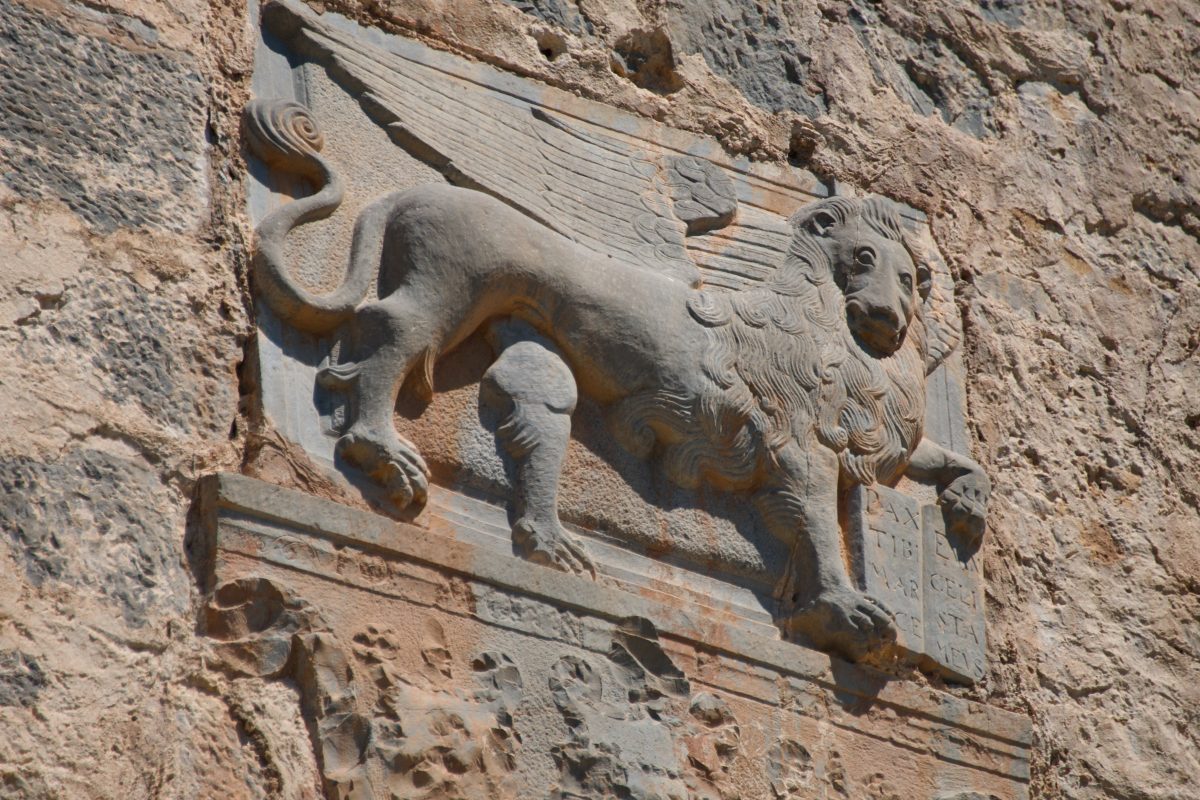
Today, Spinalonga is known throughout the world primarily for the extraordinary human story of the leprosy community that lived on the island during the 20th century.
But Spinalonga has many histories.
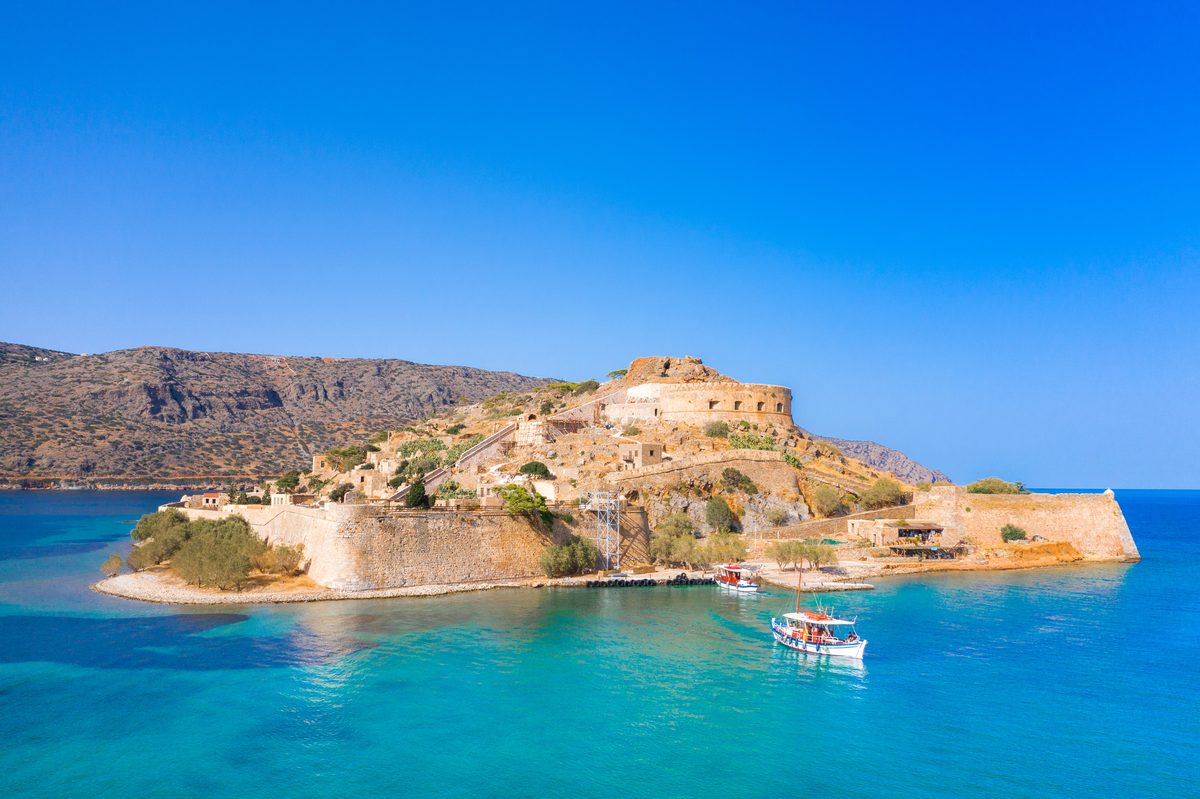
Long before the hospital, the patients and the settlement remembered in old photographs, this small rocky island at the entrance to the natural harbour of Elounda became one of Venice’s great maritime fortresses in the Mediterranean.
In 1579, the Venetians began the construction of the great fortifications that transformed Spinalonga into a formidable stronghold, designed to defend a harbour of immense strategic importance.
Massive walls rose from the rock.
Cannons guarded the approaches.
Battlements looked towards the surrounding coast.
And upon those fortifications Venice placed its unmistakable mark:
the Winged Lion of Saint Mark.
Who Is the Lion of Spinalonga?
The Lion is not simply the symbol of the city of Venice.
He represents Saint Mark the Evangelist, patron saint of Venice and one of the four Evangelists of the Christian tradition.
In Christian iconography, Saint Mark is represented by a winged lion.
Over the centuries, Venice adopted this sacred image as the emblem of the Republic itself.
Where Venice ruled, the Lion appeared.
On palaces and gates.
Above harbours.
On fortresses.
Across the Adriatic.
Across the eastern Mediterranean.
And throughout Venetian Crete.
His presence was both religious and political.
Placed high upon the walls of a fortress, the Lion proclaimed something that required no written explanation:
Venice is here.
The Words Carved Into the Book
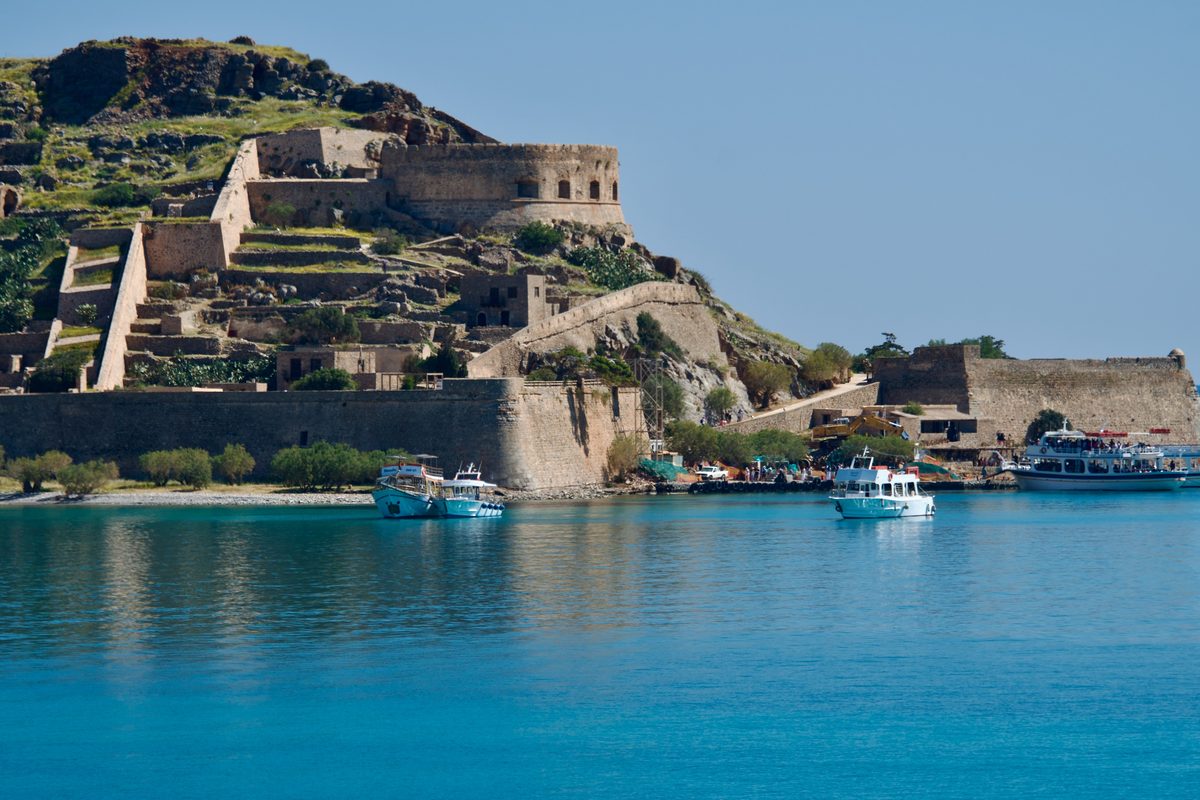
Look closely at the Lion of Spinalonga.
Beneath his paw is an open book.
Across its weathered pages can still be discerned the famous Latin words associated with Saint Mark:
PAX TIBI MARCE EVANGELISTA MEUS
They mean:
“Peace be with you, Mark, my Evangelist.”
According to Venetian tradition, these words recall the greeting of an angel to Saint Mark:
Pax tibi Marce, evangelista meus. Hic requiescet corpus tuum.
“Peace be with you, Mark, my Evangelist. Here your body shall rest.”
The tradition became deeply connected with Venice and with the presence there of the relics of Saint Mark.
Eventually, the words became inseparable from one of the most recognisable symbols of the Venetian Republic: the Winged Lion resting his paw upon the open Gospel.
And somehow, across hundreds of miles of Mediterranean Sea, those same words came to be carved into the stone of Spinalonga.
Why Is the Book Open?
There is another fascinating detail in the Lion of Spinalonga: the Gospel is open.
In the most familiar form of the Venetian emblem, the Winged Lion of Saint Mark rests one paw upon an open book displaying the words:
PAX TIBI MARCE EVANGELISTA MEUS
— “Peace be with you, Mark, my Evangelist.”
A popular interpretation holds that the open book represented Venice at peace, while representations of the Lion with a closed book or a sword were associated with war. The symbolism is compelling, although historians caution that this was not an absolute rule in Venetian iconography.
What is certain at Spinalonga is far more interesting.
The sculptor deliberately allowed the Gospel to be seen.
The book is open.
The words are exposed.
And the first word presented to everyone approaching this immense military fortification is:
PAX — PEACE.
That makes the Lion of Spinalonga even more striking.
Above cannon ports and battlements, Venice did not carve only the image of its power.
It carved a Lion holding an open Gospel.
And upon that Gospel, a message of Peace.
The Barbariga Demi-Lune
The Lion was not placed on an insignificant section of wall.
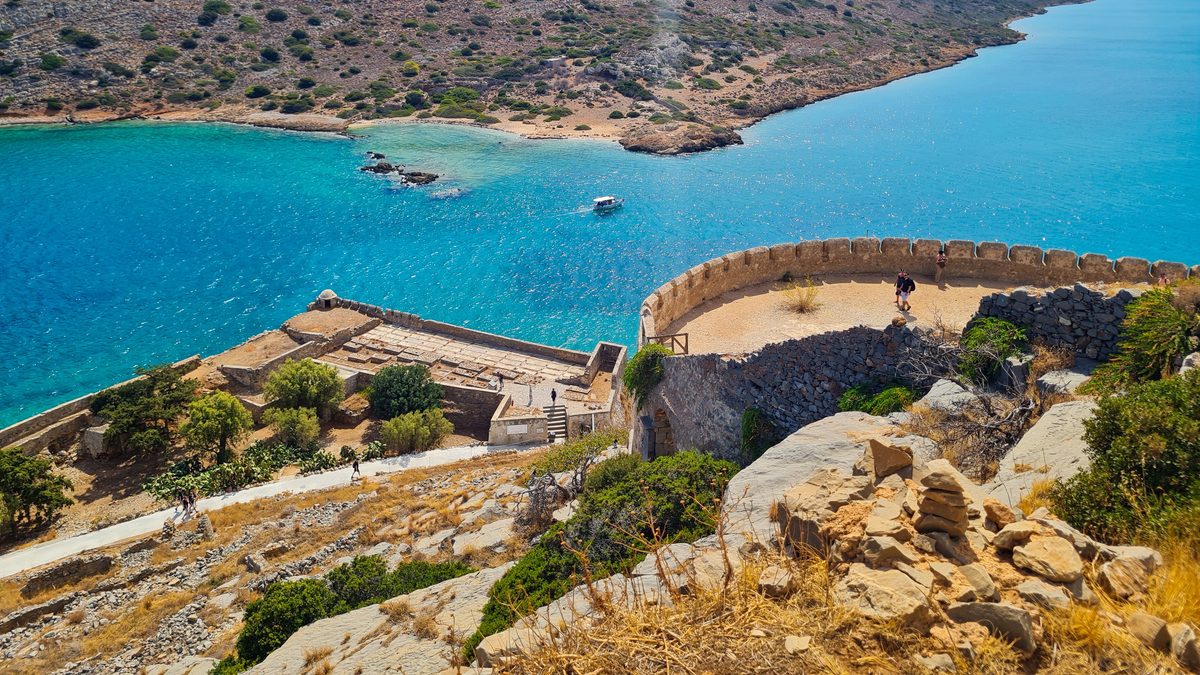
He stands on the exterior of one of Spinalonga’s most impressive defensive works: the great Barbariga demi-lune, also known as the Moceniga or Veniera demi-lune.
The fortification was constructed to protect the southern front of Spinalonga against attack from the opposite heights of the Kolokytha Peninsula.
Even its different names preserve the memory of the Venetian officials connected with its construction.
It was called Barbariga in honour of Agostino Barbarigo, the first Provveditore of the fortress.
It was also known as Moceniga, after Zuanne Mocenigo, General Provveditore of the Kingdom of Crete, who laid the foundation stone of this particular defensive work in 1581.
And the name Veniera recalls Lorenzo Venier, the Provveditore of the fortress who supervised its construction.
This was serious military architecture.
Five arched cannon ports were opened within the enormous structure. Four faced towards the heights of Kolokytha, while another guarded the entrance to the harbour.
Above them were 33 battlements.
And on the exterior, overlooking this architecture of defence and war, stood the Winged Lion.
The seal of Venice upon the fortress.
Look Beneath the Lion
There is another detail that most visitors never notice.
Immediately below the relief, traces of three damaged coats of arms can still be distinguished.
The Ephorate of Antiquities of Lasithi also records an inscription bearing the name of Mocenigo, although today it is no longer clearly visible.
The Lion therefore did not originally stand alone.
The whole composition was a monumental statement.
The Lion of Saint Mark.
The name of the Venetian official.
The heraldic shields.
Faith, government and military power carved together into the same wall.
Almost four and a half centuries later, much has disappeared.
But the Lion remains.
When Crete Fell, Spinalonga Remained Venetian
The story becomes even more remarkable after the long Cretan War between Venice and the Ottoman Empire.
Candia — modern Heraklion — surrendered in 1669.
Venetian rule over most of Crete was over.
But Spinalonga did not fall with it.
Under the terms of the surrender, Venice retained several fortified positions, including Spinalonga.
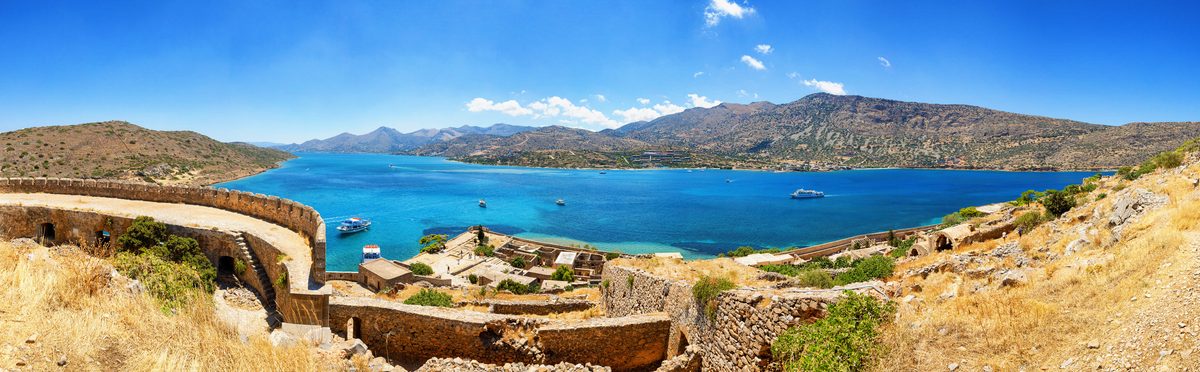
For decades after the surrounding land had passed under Ottoman control, the banner of Saint Mark continued to fly over this small Venetian stronghold in the Gulf of Mirabello.
Spinalonga finally passed to the Ottomans in 1715.
Think about that for a moment.
The political world around the island had changed.
The balance of power in Crete had changed.
Venetian rule over the island had effectively disappeared.
Yet high upon these walls, the Lion remained.
Looking towards the same sea.
Holding the same Gospel.
Bearing the same words.
PAX TIBI MARCE.
Empires Pass. Stone Remembers.
The Venetian soldiers disappeared.
The flags changed.
The Ottoman period came.
New generations lived upon the island.
Centuries later, Spinalonga became associated with an entirely different chapter of history: the community of people affected by leprosy, whose lives transformed the meaning of the island forever.
Eventually, even the Republic of Venice itself vanished from history.
But the Lion stayed.
The Cretan sun burned above him.
The winter rain crossed his face.
The salt air of Mirabello slowly weathered the stone.
The men who ordered him carved became names in archives.
Yet his wings survived.
The Gospel survived.
And one word remained:
PAX.
Spinalonga Is More Than One Story
This small relief tells us something important about Spinalonga itself.
Spinalonga cannot be understood through a single chapter of history.
It is fortress and harbour.
It is Venice.
It is the Ottoman period.
It is isolation and suffering.
It is resilience and human dignity.
It is a place where different centuries have been written one over another, almost like layers upon the same stone.
That is why Spinalonga rewards the visitor who does more than simply walk around it.
It rewards the person who looks.
So when you visit, do not look only at the houses.
Do not look only through your camera towards Elounda.
Look up at the fortifications.
Find the Winged Lion.
Look at the open Gospel beneath his paw.
And try to make out the letters that have survived there for centuries:
PAX TIBI MARCE EVANGELISTA MEUS.
“Peace be with you, Mark, my Evangelist.”
Then look around you.
At the cannon ports.
At the battlements.
At the massive walls built in anticipation of war.
And consider the extraordinary choice of the word carved above them:
PEACE.
Discover Spinalonga Beyond the Guidebooks
At Stefanos Tours in Sissi, Crete, we believe that travelling is not simply about reaching a famous place.
It is about understanding what you are looking at when you get there.
Spinalonga receives visitors from all over the world. Yet some of its finest stories are not hidden behind locked doors or inside museums.
They are there in plain sight.
Carved into the walls.
Waiting for someone to stop and notice them.
The Winged Lion of Saint Mark is one of those stories.
Without knowing what he represents, you might walk straight past him.
Now you know where to look.
When you find him, stop for a moment.
Look at the weathered stone.
Look at the wings.
Look at the Gospel.
Read the words:
PAX TIBI MARCE EVANGELISTA MEUS.
“Peace be with you, Mark, my Evangelist.”
Nearly four and a half centuries have passed since Venice began building the great fortress of Spinalonga in 1579.
The Republic that built it is gone.
Its soldiers are gone.
Its banners are gone.
Venice has fallen silent.
But her Lion still speaks from the stone of Spinalonga.
Now Come and See the Lion for Yourself
Reading about the Winged Lion of Saint Mark is one thing.
Standing beneath the walls of Spinalonga, looking up at the weathered stone and finding the words PAX TIBI MARCE EVANGELISTA MEUS with your own eyes is something entirely different.
And that is exactly why we write these stories at Stefanos Tours.
We do not want our guests simply to arrive at Spinalonga, take a few photographs and leave.
We want you to know what you are looking at.
To recognise the Venetian walls.
To understand why this tiny island was so important.
To find the Lion of Saint Mark.
And perhaps to stop beneath him for a moment and think about the extraordinary message of Peace carved above the cannons of a fortress built for war.
Visit Spinalonga from Sissi with Stefanos Tours
If you are staying in Sissi, Crete, you can experience Spinalonga with us on one of our organised excursions to the island.
Our classic Spinalonga, Elounda & Agios Nikolaos Day Trip combines some of the most beautiful and historically important places in Eastern Crete in one full day.
The excursion includes return transportation from Sissi, a professional multilingual guide, the boat journey to Spinalonga, time to explore the island, a visit to picturesque Elounda and time in Agios Nikolaos. Hotel pick-up and return from accommodation in Sissi are included. The entrance fee to Spinalonga is paid separately.
For visitors who would like a different experience, Stefanos Tours also offers our Agios Nikolaos & Spinalonga Guided Excursion from Sissi, combining a comfortable transfer to Agios Nikolaos with free time in the town, a cruise across beautiful Mirabello Bay and a guided visit to Spinalonga.
Whichever way you choose to visit, remember one thing when you arrive:
Look up.
Find the Lion.
Look beneath his paw.
Read the words carved into the Gospel:
PAX TIBI MARCE EVANGELISTA MEUS.
“Peace be with you, Mark, my Evangelist.”
Nearly four and a half centuries have passed since Venice began constructing the great fortress of Spinalonga in 1579.
The Republic that built it is gone.
Its soldiers are gone.
Its banners are gone.
Venice has fallen silent.
But her Lion still speaks from the stone of Spinalonga.
Discover Spinalonga with Stefanos Tours
Stefanos Tours — Sissi, Crete
Meet your local friend in Crete.
Come and discover Spinalonga not simply as a place to visit, but as a story waiting to be understood.