
Why Do Cretan Drivers Cross Themselves at Selinari?
15/07/2026
Kritsa, Crete: A Complete Local Guide to the Traditional Village
16/07/2026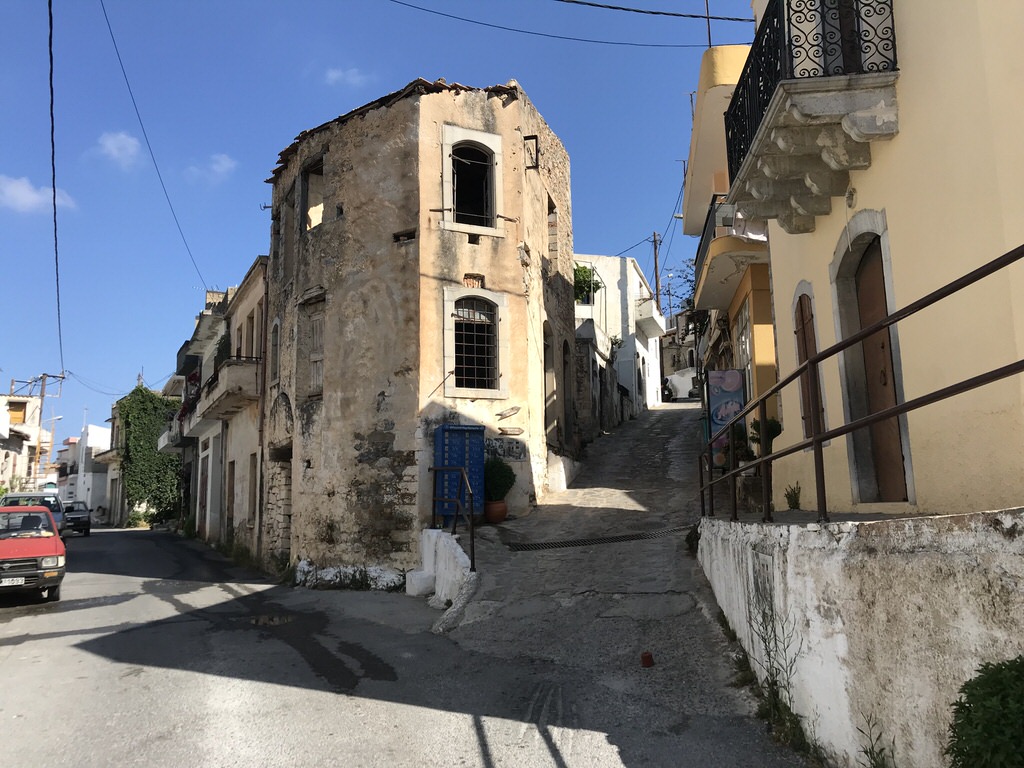
Thousands of visitors stay in Sissi every summer, yet only a small number travel into the surrounding mountains to discover the village that has watched over this coastline for generations. This is Vrachasi Crete
Vrachasi has no famous beach, luxury marina or organised tourist attractions. It does not compete for attention with large signs or carefully designed experiences.
What it offers is something increasingly difficult to find: the everyday atmosphere of a genuine Cretan village.
Built on the slopes above the northern coast, Vrachasi is surrounded by rugged mountains, olive groves and dramatic rocky scenery. Its traditional houses, narrow streets, old churches and village cafés reveal a side of Crete that can easily remain hidden from those who never leave the coastal resorts.
The village is only a short drive from Sissi, Milatos and Selinari Gorge. Nevertheless, many travellers pass close to it without ever turning off the main road.
That is a pity, because Vrachasi is more than a convenient stop between better-known destinations. It is closely connected with the history and identity of the entire surrounding area—including Sissi itself.
Where Is Vrachasi Crete?
Vrachasi is situated in the region of Lasithi, in eastern Crete, approximately 15 minutes by car from Sissi.
The village occupies a strategic position between the northern coast and the inland plain of Neapoli. Selinari Gorge lies to the west, while the impressive mountain ridge of Anavlochos rises above the village.
Vrachasi, Sissi and Milatos belong to the same wider local community and share strong historical and family connections. Long before tourism transformed the coast, many families living in Sissi had their roots in Vrachasi.
The coastal area provided fishing, agriculture and later tourism, while the mountain village offered protection, community life and access to the land.
For visitors staying in Sissi, Vrachasi is therefore not simply another neighbouring village. It is part of the story behind the destination they see today.
A Village Above the Tourist Coast
The contrast between Vrachasi and the nearby coastal resorts is immediate.
Within a short drive, hotel entrances and busy summer roads give way to steep mountain slopes, traditional buildings and a slower rhythm of life.
Vrachasi was built inland at a time when the coast was not always the safest or most desirable place to live. Pirate raids, insecurity and limited infrastructure encouraged many Cretan communities to establish themselves away from exposed shorelines.
The elevated position offered natural protection and allowed residents to observe the surrounding routes and valleys.
Today, the village continues to overlook a landscape that has changed dramatically. Below it, the northern coast welcomes thousands of international visitors. In Vrachasi, however, daily life remains centred on homes, small businesses, agriculture, family and the local community.
This does not mean the village has remained frozen in time. Cars, modern homes and contemporary life are all present. Authenticity does not require a village to pretend that the 21st century never arrived.
What makes Vrachasi authentic is that it continues to exist primarily for the people who live there—not as a performance staged for tourists.
Walking Through the Village
Vrachasi is best explored slowly and on foot.
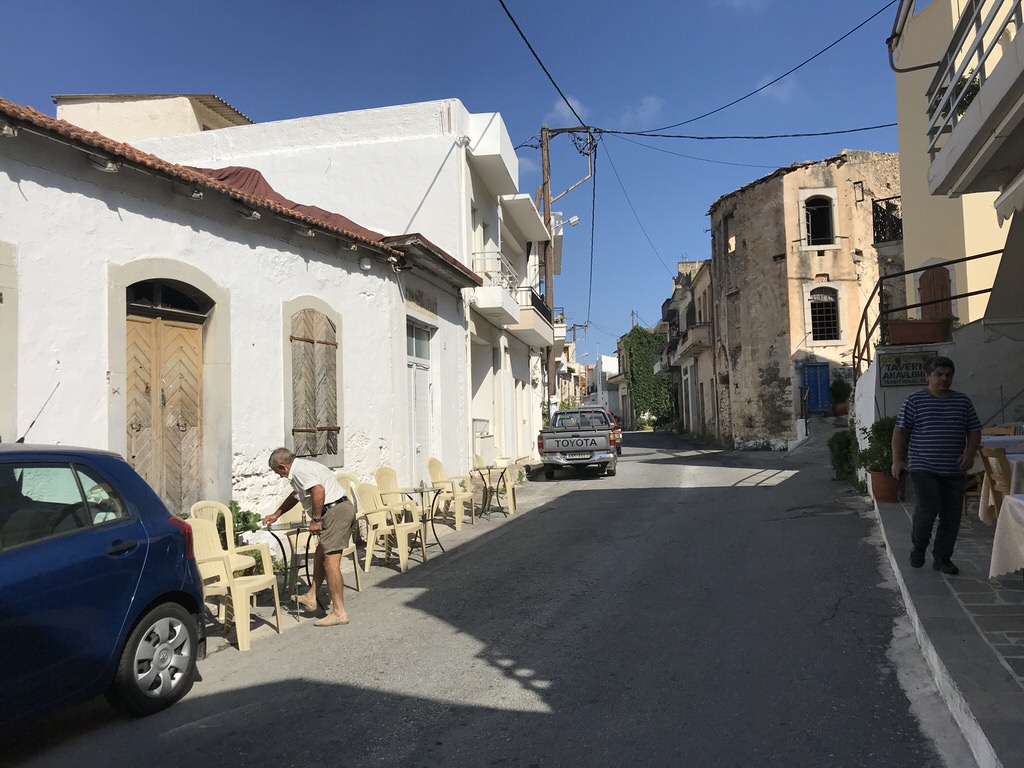
After parking responsibly, walk through the village streets without worrying about following a strict sightseeing route. Part of the pleasure is allowing the narrow roads and alleys to guide you.
You will see old stone houses standing beside newer buildings, small courtyards, balconies, arches and details that reflect the traditional architecture of the region.
Some houses have been carefully restored. Others carry the visible marks of time, emigration and changing family life. Together, they tell a more honest story than a perfectly preserved tourist village ever could.
Look for the old doorways, carved stone frames and shaded corners where residents once gathered to escape the summer heat.
You may pass elderly villagers sitting outside their homes or people meeting for coffee. A simple “kalimera” is always appreciated.
There is no need to photograph every doorway or peer into private courtyards. Vrachasi is a living residential community, and visitors should behave as guests rather than explorers entering an abandoned settlement.
The village rewards observation. Its character is found in small details rather than a single spectacular monument.
The Village Square and Local Cafés
Like many traditional communities in Crete, social life in Vrachasi has long revolved around its central gathering places.
The local café, or kafeneio, is more than somewhere to buy a drink. Historically, it served as a meeting point where residents discussed work, politics, agriculture, family matters and village news.
Although village life has changed, cafés remain important social spaces.
Stopping for a Greek coffee or cold drink allows you to experience Vrachasi at its natural pace. Do not expect the polished service style of a large resort. The atmosphere is usually simpler, more personal and more relaxed.
If food is available, you may find traditional dishes or small plates prepared according to the season. Menus and opening hours can vary, particularly outside the main summer period.
The best way to enjoy the experience is without unnecessary expectations. Sit down, observe the village and allow time for conversation.
Visitors who speak a few words of Greek will often receive a warm response. Even a simple “efcharistó” when leaving shows appreciation.
Traditional Houses and Local Architecture
Vrachasi has been officially recognised as a traditional settlement, reflecting the architectural and cultural character preserved within the village.
Traditional Cretan homes were shaped by the materials and needs of their environment. Stone was readily available, walls were built thick to provide insulation and openings were often smaller than those found in modern houses.
The buildings were not designed simply for appearance. They had to protect families from heat, cold, wind and insecurity.
Courtyards provided space for cooking, washing, storing agricultural products and carrying out everyday household work. Animals, tools and food supplies often occupied areas close to the family home.
Over time, many buildings were expanded or modified as families grew and living conditions improved. Concrete and modern materials became common, while some traditional houses were abandoned when residents moved to cities, the coast or abroad.
This mixture of architectural periods is part of Vrachasi’s story. It reflects a community that has experienced poverty, migration, tourism and social change.
The village is not an artificial collection of restored façades. Its buildings show how rural Crete has adapted while trying to preserve its identity.
Churches and Religious Life
Churches have always played an important role in Cretan village life.
They were not used only for Sunday worship. Baptisms, weddings, funerals, feast days and religious processions brought the community together and marked the most important moments in family life.
Vrachasi contains several churches and small chapels connected with different periods of the village’s history.
Visitors are generally welcome to enter an unlocked church, provided they behave respectfully. Shoulders and upper legs should be covered, voices kept low and mobile phones placed on silent mode.
Some churches may remain locked outside services, particularly when they contain old icons or valuable religious objects. Do not attempt to force an entrance or enter private ecclesiastical areas.
If you happen to visit during a local feast, you may witness a side of village life rarely experienced in the coastal resorts. Religious celebrations often combine worship with food, music and community gathering.
For the people of Vrachasi, faith is not separated from local identity. The churches preserve memories of generations who lived, worked and died in the village.
The Vrachasi Folklore Collection
Visitors interested in traditional life should look for information about the local folklore collection, often referred to as the Vrachasi House.
The collection preserves objects connected with domestic life, agriculture, crafts and the history of the community.
Items such as household utensils, textiles, furniture, tools and traditional clothing can help visitors understand how families lived before electricity, modern transport and tourism changed the region.
A simple agricultural tool may reveal more about village life than a long written description. It represents physical labour, limited resources and skills passed from one generation to the next.
Opening arrangements may not be as regular as those of a major museum, so check locally before planning your visit around it.
Even when the collection is not accessible, the concept behind it is important. It shows a desire within the community to protect the memory of a way of life that is rapidly disappearing.
Anavlochos: The Mountain Above Vrachasi
The most dramatic feature of the landscape is Anavlochos, the long limestone ridge rising above Vrachasi.
It extends for approximately five kilometres and forms a natural defensive position overlooking the village and the wider region of Mirabello.
To the casual visitor, Anavlochos may appear to be simply another rugged Cretan mountain. Archaeological research, however, has revealed that people lived, worshipped and buried their dead on this difficult terrain thousands of years ago.
The ridge was first investigated by French archaeologist Pierre Demargne in 1929. More recent surveys and excavations have been conducted by the French School at Athens in cooperation with the Greek archaeological authorities.
Archaeologists have identified evidence of an ancient settlement, burial areas and religious activity. The occupation is particularly important for understanding the period between the end of the Bronze Age and the development of the early Greek city-states.
The strategic position gave the inhabitants wide views across the valleys, routes and coastal plain. Its natural defences were valuable during a period of movement and uncertainty.
Research at Anavlochos continues to improve our understanding of early communities in eastern Crete. According to the archaeological project, surveys conducted in 2015 and 2016 helped clarify the extent, character and chronology of occupation across the ridge. Anavlochos Project – University of Cincinnati
Can You Hike to Anavlochos?
Anavlochos is fascinating, but it should not be treated like a casual tourist viewpoint.
The terrain is steep, rocky and exposed. Paths may be unclear, and there is limited shade. Summer temperatures can make the climb dangerous, especially during the middle of the day.
Visitors should not attempt the route in flip-flops or beach clothing.
A proper hike requires:
- Strong walking shoes
- Sufficient drinking water
- Sun protection and a hat
- A charged mobile phone
- Knowledge of the route
- Suitable weather conditions
- Respect for archaeological remains
Never remove pottery, stones or any object that may have archaeological importance. Moving even a small fragment destroys part of the information researchers use to understand the site.
Avoid climbing on ancient walls or entering active excavation areas. Archaeological remains belong to the cultural heritage of Greece and are protected by law.
Travellers without hiking experience should admire the ridge from the village or arrange to explore the area with knowledgeable local guidance.
There is no shame in deciding that the conditions are unsuitable. The mountain has stood above Vrachasi for thousands of years; it will still be there on a cooler and safer day.
The Connection Between Vrachasi and Sissi
To understand Sissi fully, it helps to understand Vrachasi.
Today, Sissi is known as a seaside destination with hotels, restaurants, apartments and excursion offices. Tourism plays a major role in the local economy.
But the coast was not always the centre of community life.
Many families associated with modern Sissi came from Vrachasi and the surrounding inland settlements. They cultivated land, kept animals, traded, fished and gradually developed stronger connections with the sea.
As transport improved and tourism expanded, economic activity increasingly moved toward the coast. New homes and businesses appeared, and Sissi developed into the destination visitors know today.
However, family connections between the mountain and the coast remained strong.
This relationship explains why Vrachasi should not be presented as a completely separate destination. It is part of the same local story—a reminder of the agricultural and village roots that existed long before package holidays arrived in Crete.
As a local whose family has lived in this wider area for generations, I see Vrachasi not simply as a place on the map, but as part of the identity of Sissi and the surrounding villages.
The coast may attract the visitors, but much of the region’s memory still lives in the mountains.
Local Agriculture and the Surrounding Land
The landscape around Vrachasi has supported generations through agriculture and animal husbandry.
Olive trees are the most visible crop. Their ability to survive dry summers and rocky soil made them essential to rural life. Olive oil was used for food, lighting, religious purposes and trade.
Carob trees, vines, vegetables and small areas of grain cultivation also contributed to the local economy, depending on the period and the available land.
Sheep and goats were particularly suited to the surrounding mountain terrain. They provided milk, cheese, meat and wool.
Agricultural life was physically demanding. Before modern machinery, families depended on human labour, animals and detailed knowledge of the seasons.
Tourism has changed employment throughout the region, but olive cultivation and small-scale agriculture remain important to many local households.
When you look at the terraces, stone walls and groves around Vrachasi, you are not seeing empty countryside. You are looking at a landscape shaped by centuries of work.
When Is the Best Time to Visit?
Vrachasi can be visited throughout the year, but each season offers a different experience.
Spring is particularly attractive. The surrounding hills are greener, wildflowers appear and temperatures are suitable for walking.
Early summer offers warm weather without the most extreme heat. July and August can be very hot, so visit in the morning or late afternoon.
Autumn is associated with agricultural activity, including preparation for the olive harvest. The light becomes softer, and the village returns to a quieter rhythm after the main tourism season.
Winter reveals Vrachasi as a real year-round community rather than a seasonal resort. Some cafés or visitor facilities may have limited opening hours, but ordinary village life continues.
For most summer visitors, the best time is late afternoon. Walk through the village as the temperature falls, stop for a drink and enjoy the changing light across the mountains.
How Long Do You Need in Vrachasi?
Vrachasi does not require an entire day unless you are planning a carefully prepared hike.
For a relaxed walk and coffee, allow approximately one to two hours.
If the folklore collection is open or you intend to eat in the village, allow more time.
A possible half-day itinerary could include:
- Morning visit to Saint George Selinari Monastery
- Walk through Vrachasi
- Coffee or lunch in the village
- Afternoon visit to Milatos
- Swim or early dinner beside the sea
This route combines religious tradition, mountain life, history and the coast without requiring long driving distances.
Getting to Vrachasi from Sissi
The easiest way to reach Vrachasi is by car, taxi or private transfer.
From Sissi, the journey usually takes approximately 15 minutes, although this depends on the exact route and traffic.
Roads within the village can be narrow. Park in an appropriate open area and continue on foot rather than trying to drive through every small street.
Do not block house entrances, agricultural access points or the route used by local vehicles.
Public transport can be limited, particularly outside the busiest season. Check current schedules locally rather than relying on older information found online.
The short distance from Sissi makes Vrachasi ideal for a spontaneous visit. You do not need to wake up before sunrise or spend hours on a coach to experience a very different side of Crete.
Combine Vrachasi With Nearby Destinations
Vrachasi is well placed for exploring several neighbouring locations:
- Saint George Selinari Monastery: Discover why Cretan drivers make the sign of the cross when passing through the gorge.
- Milatos: Enjoy a small fishing harbour, seaside tavernas and the historic Milatos Cave.
- Sissi: Walk around the natural harbour and enjoy the relaxed coastal atmosphere.
- Neapoli: Explore an authentic inland town with a traditional central square and important churches.
- Malia Palace: Visit one of eastern Crete’s major Minoan archaeological sites.
- Potamos Beach: Relax on a long sandy beach near the archaeological site of Malia.
Avoid trying to visit every destination on the same day. Vrachasi is best experienced without a strict schedule.
Is Vrachasi Worth Visiting?
Vrachasi is worth visiting precisely because it does not behave like a conventional tourist attraction.
There is no entrance ticket, no famous monument surrounded by crowds and no carefully designed route telling visitors where to stand and what to photograph.
Instead, there is a living village, traditional architecture, mountain scenery, local cafés and an archaeological landscape that reaches back thousands of years.
Some travellers may arrive expecting constant entertainment and leave wondering what they were supposed to see.
Others will understand immediately.
The purpose of visiting Vrachasi is not to collect attractions. It is to experience the quieter inland character of Crete and recognise that the coastal resorts are only one part of the island’s identity.
Walk slowly. Notice the houses. Look toward Anavlochos. Sit down for a coffee and imagine the generations who travelled between this mountain village and the coast below.
Thousands of tourists visit Sissi every year.
Only a few make the short journey to Vrachasi.
Those who do discover not a hidden attraction, but something far more valuable: the village behind the destination.