
Milatos, Crete: A Quiet Seaside Village Just 15 Minutes from Sissi
15/07/2026
Vrachasi, Crete: The Mountain Village Most Tourists Never Enter
15/07/2026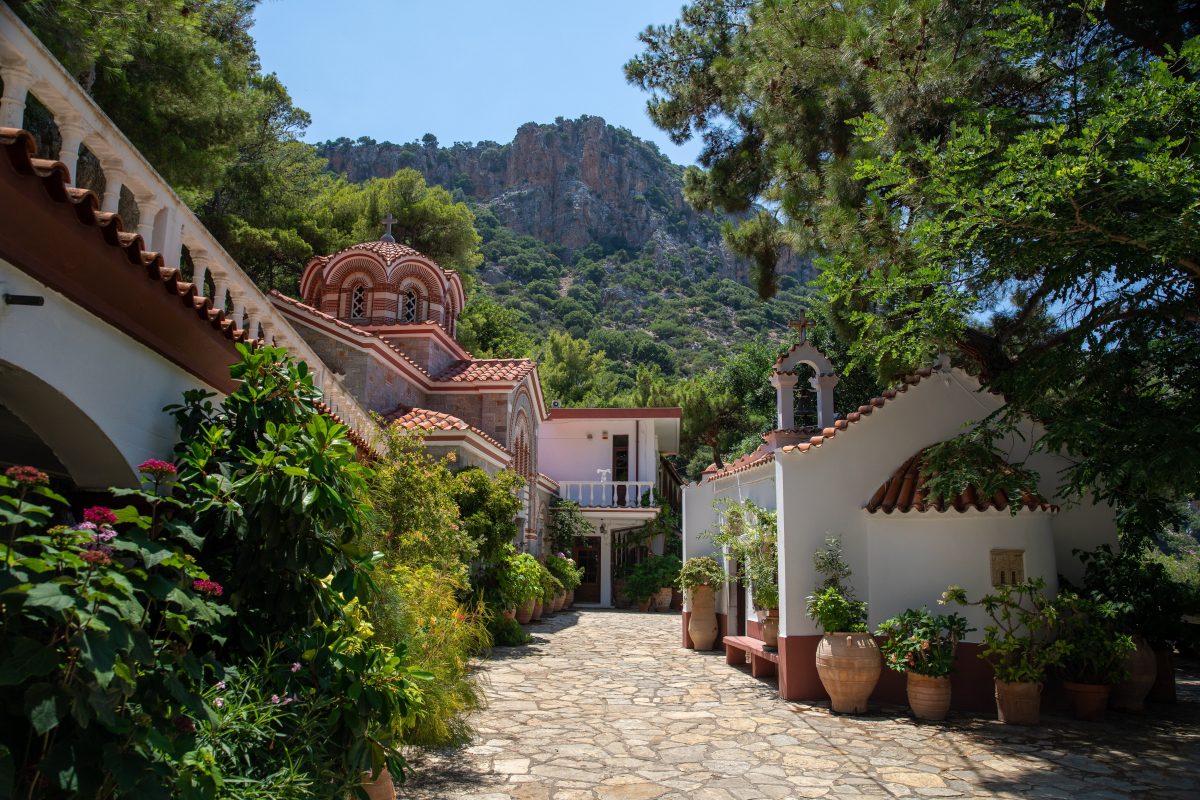
Every day, thousands of travellers pass through Selinari Monastery (Gorge) on the main road connecting Heraklion with Agios Nikolaos and eastern Crete.
Many notice something unusual as they approach the narrow passage through the mountains: local drivers briefly remove one hand from the steering wheel and make the sign of the cross.
Taxi drivers, bus drivers, lorry drivers and local families have followed this custom for generations. Some slow down for a moment. Others stop at the monastery beside the road, light a candle and continue their journey.
But why do they do it?
The answer lies at the Monastery of Saint George Selinari, one of eastern Crete’s most beloved places of pilgrimage. Although thousands of tourists drive past it every day, relatively few stop to discover its history.
The monastery is dedicated to Saint George, one of the most widely venerated Christian saints in the world—and, perhaps surprisingly for many British visitors, the patron saint of England.
Located only a short distance from Sissi, the monastery offers visitors an opportunity to experience a place where Cretan history, Orthodox faith and a centuries-old tradition of protecting travellers come together.
Where Is Selinari Monastery?
The Monastery of Saint George Selinari is situated inside Selinari Gorge, between the traditional village of Vrachasi and the town of Neapoli.
It stands directly beside the main national road connecting Heraklion with Agios Nikolaos. Anyone travelling from Heraklion Airport toward Sissi, Milatos, Elounda or eastern Crete will almost certainly pass it.
From Sissi, the journey takes approximately 10–15 minutes by car, depending on your starting point and traffic conditions.
Despite its location beside a busy road, the monastery has a surprisingly peaceful atmosphere. The steep walls of the gorge rise around it, separating the religious complex from the coastal resorts only a few kilometres away.
Many travellers see the monastery from their bus or rental car but assume it is simply a small roadside church. In reality, it is an important place of pilgrimage with a long history and a particularly strong relationship with drivers and travellers.
Why Do Drivers Cross Themselves at Selinari?
For many Cretans, passing Selinari without making the sign of the cross would feel strange.
The gesture is an expression of faith and respect toward Saint George. It is also a short prayer for protection before continuing through the gorge and along the road.
In earlier times, this journey was far more difficult than it is today. The old road through the mountains was narrow, steep and dangerous. Travellers faced poor surfaces, falling rocks, animals and difficult weather conditions.
The monastery became a natural stopping point where people could rest, pray and ask Saint George to protect them during their journey.
Even though the modern road is considerably safer, the tradition has survived.
Today, local drivers may cross themselves without stopping, while others enter the monastery to light a candle. Some give thanks for a journey completed safely. Others pray for relatives who work as professional drivers or spend long periods travelling.
There is also a widely repeated local belief that a traveller should not pass Saint George Selinari without showing respect. Stories are told of drivers who ignored the monastery and later experienced mechanical problems or difficulties on the road.
These accounts belong to local religious tradition rather than something that can be historically proven. Nevertheless, they reveal how deeply the monastery is connected with the spiritual life of the region.
For Cretans, the gesture is not superstition or a performance for visitors. It is a small act of faith that has become part of the journey itself.
The History of Saint George Selinari
The religious history of Selinari extends back many centuries.
According to historical and ecclesiastical accounts, a monastery existed in the area during the Byzantine period. It was later destroyed, and the site passed through a long period of abandonment.
The monastery’s modern story is closely associated with a monk named Nikolaos, who came from Rhodes during the 16th century.
According to tradition, Nikolaos and his two brothers left Rhodes following the Ottoman conquest of the island and eventually settled in the area around Vrachasi.
Nikolaos chose the monastic life and lived as an ascetic in the isolated landscape of Selinari. One night, he reportedly saw a light shining on the opposite side of the gorge. When he investigated, he discovered an icon of Saint George.
He interpreted this as a divine sign and built a small church on the site, dedicating it to the saint. The old chapel preserved within the present monastery is associated with this tradition.
Nikolaos remained at Selinari for the rest of his life. According to local accounts, he was buried in a small cave near the top of Anavlochos, overlooking the wider region.
Over the centuries, the monastery went through periods of decline, abandonment and restoration. The surrounding area was improved during the 20th century, while a larger church was constructed beside the historic chapel in 1961.
Today, the monastery continues to welcome pilgrims, local residents and travellers from around the world. Its story remains inseparable from the monk who followed a mysterious light through the gorge and discovered the icon of Saint George. Holy Metropolis of Petra and Cherronissos
Who Was Saint George?
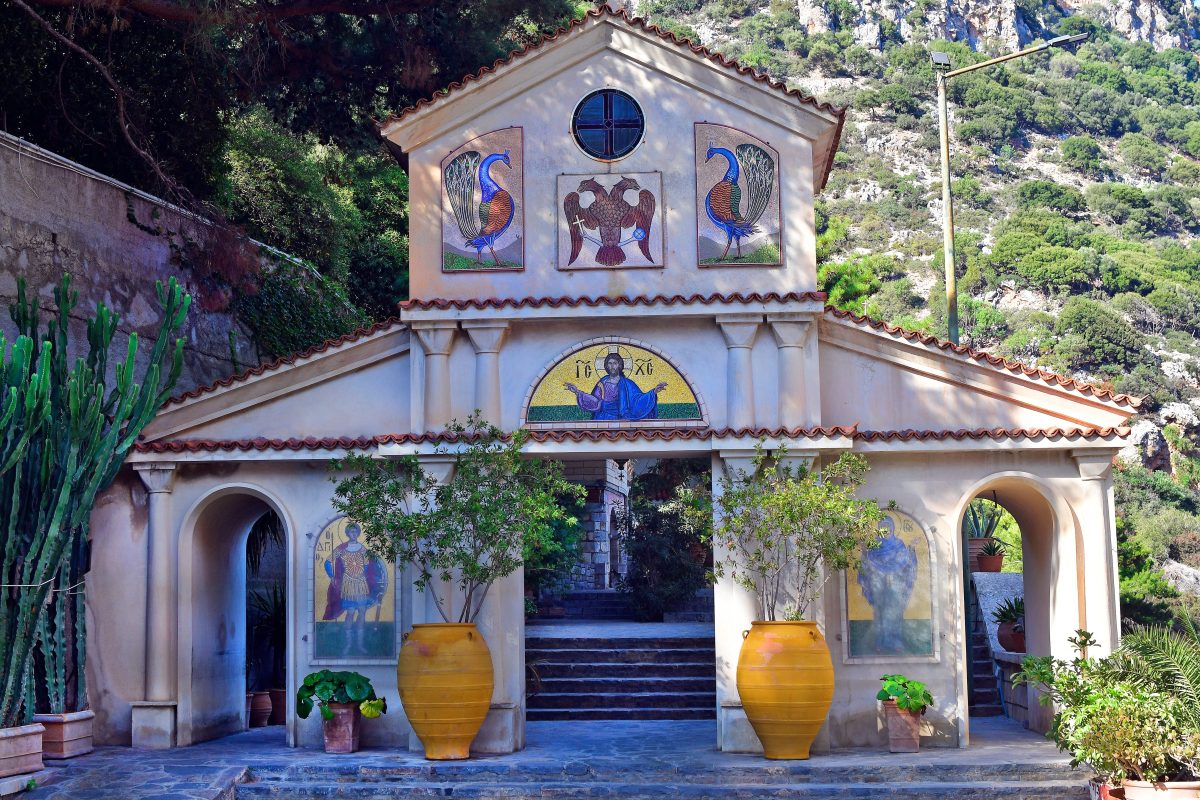
Saint George is among the most recognised saints in Christianity.
Although much of his life is known through Christian tradition, he is generally believed to have lived during the late third and early fourth centuries. He served as a soldier in the Roman army and was martyred around AD 303 during the persecution of Christians under Emperor Diocletian.
According to tradition, George refused to renounce his Christian faith despite imprisonment and torture. His courage and steadfastness led to his recognition as a martyr.
In the Orthodox Church, he is known as Saint George the Great Martyr and Trophy-Bearer. Churches, monasteries and chapels dedicated to him can be found throughout Greece.
He is often depicted as a young soldier riding a white horse and striking a dragon with his spear. This famous image is based on a later medieval legend rather than a documented event from his life.
In Christian symbolism, the dragon represents evil, fear and spiritual darkness. Saint George’s victory therefore represents the triumph of faith and courage over evil.
His feast is normally celebrated on 23 April. In the Orthodox Church, however, when this date falls before or during Easter, the celebration is transferred to Easter Monday because the joyful feast cannot be celebrated during the solemn period before the Resurrection.
The name George remains extremely common in Greece, and his feast day is celebrated across the country.
Saint George: The Patron Saint of England
British visitors may be surprised to encounter such strong devotion to their national patron saint in a small Cretan gorge.
Saint George was not English and is not believed to have ever visited England. He probably lived in the eastern regions of the Roman Empire and was likely part of the Greek-speaking Christian world.
Devotion to him reached Western Europe during the Middle Ages. His image as a courageous Christian soldier became particularly popular among knights and crusaders.
Saint George became closely associated with the English monarchy during the reign of Edward III. The king placed the Order of the Garter under his patronage during the 14th century, and the saint’s red cross on a white background eventually became the national flag of England.
His feast day, Saint George’s Day, is celebrated on 23 April.
This creates an interesting connection between England and Crete. The same saint represented on England’s national flag is honoured by Cretan drivers every time they pass through Selinari Gorge.
However, Saint George belongs neither exclusively to England nor to Greece. He is venerated across many Christian traditions and cultures. Churches dedicated to him can be found throughout Europe, the Middle East and Africa.
For British travellers, Selinari offers an opportunity to meet England’s patron saint in a very different cultural setting—not as a distant figure from medieval heraldry, but as a living presence in the faith and daily customs of Crete.
As English Heritage notes, Saint George was probably a Greek-speaking Christian who lived in the Roman Near East and suffered martyrdom around AD 303. English Heritage
The Old Chapel and the Miraculous Icon
One of the most important parts of the monastery is the small historic chapel associated with Monk Nikolaos.
This modest building preserves the atmosphere of the earlier monastery and stands in contrast with the larger modern church beside it.
According to local tradition, the chapel was constructed near the place where Nikolaos discovered the icon after seeing the mysterious light in the gorge.
For pilgrims, the icon is not simply an old work of religious art. It represents the presence and protection of Saint George in the region.
Orthodox icons are not worshipped as objects. They are honoured as sacred images that direct the believer’s prayer toward Christ, the Virgin Mary or the saint depicted.
Visitors may see people standing silently before the icon, making the sign of the cross, kissing it or leaving a small offering. These actions are personal expressions of faith and should be treated respectfully.
You do not need to be Orthodox to enter the church or appreciate its atmosphere. Visitors of every background are welcome, provided they behave with sensitivity.
A Monastery Beside a Busy Road
One of the most striking features of Selinari is the contrast between its location and its atmosphere.
Cars, coaches and lorries pass only a short distance away. Yet after entering the monastery courtyard, the noise of the road seems less important.
The surrounding mountains create a natural enclosure, while the trees, stone buildings and religious images produce a sense of calm.
This is not an isolated monastery hidden several hours into the mountains. It is accessible to almost everyone travelling through the area.
That accessibility is part of its identity. Selinari does not wait at the end of a difficult pilgrimage route. It stands directly beside the road, meeting people during their everyday journeys.
Some visitors stay for only ten minutes. They light a candle, look inside the church and leave.
Others take more time to explore the courtyard, observe the architecture and sit quietly beneath the trees.
You do not need to spend hours here for the visit to be meaningful. Even a brief stop can provide a very different experience from the beaches, hotels and organised attractions of Crete.
The Natural Setting of Selinari Gorge
The monastery lies within one of the most dramatic natural passages in the region.
Selinari Gorge forms a narrow route between the northern coast and the inland plain of Neapoli. Its steep rocky slopes create a landscape very different from the nearby seaside resorts.
The gorge is also known for its wildlife. Birds of prey can sometimes be seen circling above the cliffs, while the surrounding vegetation includes typical Mediterranean shrubs and trees.
Drivers should keep their attention on the road rather than attempting to photograph the landscape while moving. If you wish to admire the gorge, stop safely at the monastery.
The older road and paths in the wider area offer views of the mountains, but visitors should not wander onto unfamiliar routes without proper footwear, water and information.
For most travellers, the monastery itself provides the safest and easiest place to experience the atmosphere of the gorge.
How to Behave When Visiting the Monastery
Saint George Selinari is an active religious site, not simply a tourist attraction.
Visitors are welcome, but a few basic rules should be observed:
- Wear respectful clothing that covers the shoulders and upper legs.
- Speak quietly inside the churches and around people who are praying.
- Place mobile phones on silent mode.
- Do not use flash photography during services.
- Ask permission before photographing monks, clergy or worshippers.
- Do not touch icons, relics or religious objects unnecessarily.
- Never enter areas marked as private.
- Supervise children and avoid allowing them to run through the churches.
- Do not leave rubbish anywhere in the monastery or gorge.
If a service is taking place, you may usually enter quietly and stand toward the back unless advised otherwise.
Non-Orthodox visitors can light a candle and attend a service, but Holy Communion is reserved for baptised Orthodox Christians who have prepared according to the practice of the Church.
The monastery does not require visitors to share the Orthodox faith. It asks only that they respect the people for whom this is a sacred place.
Lighting a Candle at Selinari
Lighting a candle is one of the simplest ways visitors participate in the atmosphere of an Orthodox church.
The flame represents prayer, hope and the light of Christ. People may light candles for their health, their families, travellers, the living or the departed.
There is usually a place near the church entrance where visitors can obtain a candle and leave a small donation.
There is no need to perform complicated rituals. Light the candle carefully, place it in the designated stand and remain silent for a moment.
For travellers, it can be a meaningful opportunity to remember someone they love or to express gratitude for a safe journey.
Many Cretan drivers stop at Selinari specifically for this purpose before continuing toward Heraklion or Agios Nikolaos.
When Is the Best Time to Visit?
The monastery can be visited throughout the year, although conditions and access may vary during services, religious celebrations or maintenance.
Morning is often the most peaceful time. The temperature is cooler, the courtyard is quieter and the light across the gorge is particularly beautiful.
The monastery becomes considerably busier around the feast of Saint George, when worshippers arrive from the surrounding villages and other parts of Crete.
If you visit during a major celebration, expect more people and limited parking. The atmosphere can be memorable, but those seeking silence may prefer an ordinary weekday.
Avoid rushing into the monastery five minutes before another scheduled activity. Allow at least 30–45 minutes if you want to see the churches and enjoy the surroundings without pressure.
How to Reach Selinari from Sissi
Saint George Selinari is very close to Sissi.
By car, drive toward the main national road and follow the direction of Agios Nikolaos or Neapoli. The monastery is visible beside the road inside the gorge.
Because the road carries fast-moving traffic, reduce your speed carefully and follow the signs when entering the parking area. Never stop suddenly on the main carriageway.
A taxi or private transfer can also take you there. If you do not have a vehicle, ask locally about transport because regular public bus services may not provide a convenient stop directly at the monastery.
The short distance makes Selinari ideal for visitors who want to discover something meaningful without dedicating an entire day to an excursion.
What Can You Combine With Selinari?
A visit to the monastery can easily be combined with several nearby destinations:
- Vrachasi: A traditional mountain village only a short distance away.
- Milatos: A quiet coastal settlement with waterfront tavernas and a historic cave.
- Neapoli: An authentic Cretan town with churches, local cafés and a pleasant central square.
- Sissi: A peaceful seaside village known for its natural harbour.
- Malia Palace: One of the most important Minoan archaeological sites in eastern Crete.
A particularly enjoyable route would begin at Selinari in the morning, continue to Vrachasi or Neapoli and finish with lunch and a swim in Milatos.
This combination introduces visitors to the religious, rural and coastal character of eastern Crete within a relatively small geographical area.
Is Selinari Monastery Worth Visiting?
Yes—especially if you are already travelling between Heraklion and eastern Crete.
The monastery is easy to reach, requires no long diversion and offers much more than most travellers expect from a roadside stop.
It tells the story of a Rhodian monk who followed a mysterious light, a historic icon discovered within a mountain gorge and a saint whose protection is still requested by Cretan drivers.
It also creates an unexpected bridge between Crete and England.
British visitors know Saint George from the red cross flying above English buildings and appearing at sporting events. At Selinari, they encounter him inside the spiritual tradition from which his veneration originally developed: as an early Christian martyr honoured for his courage and faith.
Most travellers will pass Selinari during their holiday.
Some will notice the monastery through the window. Some will see a driver make the sign of the cross and wonder why.
But those who stop will discover that this small monastery is not simply another building beside the road. It is a place of memory, prayer and protection—standing at the entrance to eastern Crete and watching over everyone who passes through the gorge.