
Elder Eugenios Kastanias (1914–2009): A Hidden Light of Mount Athos
31/07/2026
August 15 in Greece – Why the Dormition of the Virgin Mary Is Called the “Easter of Summer”
02/08/2026
The Meaning of the Gospel Reading for the Ninth Sunday of Matthew (Matthew 14:22–34)
Introduction
Few passages in the Gospels capture both the majesty of Christ and the weakness of the human heart as powerfully as the account of Jesus walking on the water.
For many readers, this is simply another miracle performed by Christ. Yet the Gospel of Matthew reveals something far deeper. This event is not only about Christ’s authority over nature; it is about faith, fear, trust, and the constant presence of God in the midst of life’s greatest storms.
Every generation experiences its own “storms.”
Some struggle with illness.
Others carry the burden of grief.
Many face financial uncertainty, family problems, loneliness, anxiety, or fear of the future.
In moments like these, the disciples’ experience on the Sea of Galilee becomes our own.
They were experienced fishermen.
They knew the sea.
They knew the wind.
Yet on that night, all their knowledge and experience proved insufficient.
The waves became stronger than their confidence.
The darkness became greater than their courage.
Then, in the darkest hours before dawn, Christ appeared.
Walking upon the waves.
And He spoke words that continue to comfort Christians nearly two thousand years later:
“Take courage! It is I. Do not be afraid.”
(Matthew 14:27)
These words are not addressed only to the disciples.
They are spoken to every believer who has ever found himself surrounded by fear. Jesus walks on water.
The Historical Setting
This remarkable event takes place immediately after one of Christ’s greatest public miracles: the feeding of the five thousand.
With only five loaves and two fish, Jesus miraculously fed an enormous crowd, leaving twelve baskets full of leftovers.
The miracle caused great excitement among the people.
According to the Gospel of John, many wanted to make Jesus king by force.
Christ, however, had not come to establish an earthly kingdom.
His Kingdom was not built upon political power but upon salvation.
For this reason, He immediately dismissed the crowd and sent His disciples away.
Matthew uses a very striking word:
“Jesus made the disciples get into the boat…”
The Greek verb literally means He compelled them.
The disciples did not choose to leave Him.
Christ Himself instructed them to cross the Sea of Galilee while He remained behind.
This detail carries profound spiritual meaning.
Sometimes believers imagine that following Christ guarantees a life without difficulties.
The Gospel teaches the opposite.
The disciples entered the storm precisely because they obeyed Christ.
Their suffering was not a sign that God had abandoned them.
It was part of their spiritual formation.
Why Did Jesus Go Up the Mountain Alone?
After sending the disciples away, Jesus climbed the mountain by Himself to pray.
This naturally raises an important question.
If Jesus is truly the Son of God, why does He pray?
The early Fathers of the Church explain that Christ does not pray because He needs strength from the Father.
Rather, He prays to teach us.
Throughout His earthly ministry, Jesus repeatedly withdrew from crowds to spend time in prayer.
He teaches that genuine prayer requires silence, solitude, and communion with God.
Saint John Chrysostom beautifully explains that Christ often instructed by His actions before teaching with His words.
Before asking His disciples to trust the Father, He first showed them what complete trust looks like.
Even today, His example reminds Christians that prayer is not simply a religious duty.
It is the source of spiritual strength.
The Sea of Galilee
The Gospel calls it a sea, but geographically it is actually a freshwater lake approximately 21 kilometers long and 13 kilometers wide.
The Sea of Galilee lies about 210 meters (690 feet) below sea level, surrounded by steep hills and valleys.
Its unique geography often produces sudden and violent storms.
Cold air rushing down from the surrounding mountains collides with the warm air rising from the lake, creating powerful winds and dangerous waves within minutes.
This explains why the disciples suddenly found themselves fighting for their lives.
Several of them—including Peter, Andrew, James, and John—had spent much of their lives fishing on this very lake.
These were not inexperienced sailors.
If they feared for their lives, the storm must have been truly terrifying.
Matthew tells us that the boat was “buffeted by the waves because the wind was against it.”
Hour after hour they struggled.
They rowed.
They fought the wind.
They exhausted every human effort.
Yet the storm only grew stronger.
The Fourth Watch of the Night
Matthew then makes an important observation:
“Shortly before dawn Jesus went out to them, walking on the lake.”
The original Greek text refers to the fourth watch of the night.
In Roman timekeeping, the night was divided into four watches.
The fourth watch lasted roughly from 3:00 a.m. until 6:00 a.m.
This means the disciples had been struggling almost the entire night before Christ appeared.
Why did He wait?
Why didn’t He calm the storm immediately?
The Fathers of the Church explain that God sometimes allows trials to continue—not because He has abandoned His people, but because trials reveal both human weakness and divine power.
Only when the disciples had exhausted their own strength were they fully prepared to discover that salvation comes from Christ alone.
This pattern appears throughout Scripture.
Abraham waited years before God’s promise was fulfilled.
Joseph endured imprisonment before becoming ruler in Egypt.
The Israelites wandered in the wilderness for forty years.
Likewise, the disciples spent an entire night battling the storm before seeing Christ approach.
God’s timing is rarely our timing.
Yet His timing is always perfect.
Faith in the Midst of the Storm
As the disciples struggled against the wind throughout the night, something extraordinary happened.
Matthew writes:
“Shortly before dawn Jesus went out to them, walking on the sea.”
(Matthew 14:25)
This single sentence contains one of the clearest revelations of Christ’s divine authority.
Throughout the Old Testament, the sea often represents chaos, danger, and forces beyond human control.
Only God has authority over the waters.
The Book of Job declares that God alone “treads upon the waves of the sea” (Job 9:8).
By walking upon the water, Jesus is not merely performing an impressive miracle.
He is revealing His identity.
The Creator is walking upon His own creation.
Fear Can Blind Even the Faithful
Matthew continues:
“When the disciples saw Him walking on the sea, they were terrified. ‘It is a ghost,’ they said, and cried out in fear.”
The disciples had spent years with Jesus.
They had witnessed miracles.
They had heard His teaching.
Yet fear distorted their perception.
Instead of recognizing Christ, they imagined they were seeing a ghost.
This is one of the most profound psychological observations found in Scripture.
Fear changes the way people see reality.
When anxiety dominates the human heart, even hope may appear frightening.
How often does the same happen today?
A difficult medical diagnosis suddenly convinces someone that all hope is gone.
Financial hardship makes the future appear hopeless.
A family crisis overshadows every blessing that still remains.
Fear magnifies the storm until it becomes impossible to see anything else.
The disciples were not seeing reality as it truly was.
They were seeing reality through the lens of fear.
“Take Courage. It Is I. Do Not Be Afraid.”
Then Jesus speaks.
Only three short sentences.
Yet they contain enough comfort to sustain believers in every generation.
“Take courage! It is I. Do not be afraid.”
Every word deserves careful attention.
“Take courage.”
Christ does not deny the existence of the storm.
He does not pretend that danger is absent.
Instead, He gives the disciples something stronger than the storm itself—courage.
Biblical courage is not the absence of fear.
It is the willingness to trust God despite fear.
This distinction is essential.
Even the greatest saints experienced fear.
What distinguished them was not extraordinary bravery but extraordinary trust.
“It is I.”
The Greek text simply says:
“ἐγώ εἰμι” — “I AM.”
These words carry tremendous theological significance.
To modern readers they may sound like a simple identification.
To Jewish ears, however, they echoed God’s revelation to Moses at the burning bush:
“I AM WHO I AM.”
(Exodus 3:14)
Throughout John’s Gospel, Jesus repeatedly uses these same words when revealing His divine identity.
Here, standing upon the sea, those words take on even greater meaning.
The One speaking is not merely a teacher from Nazareth.
He is the Lord of creation.
The sea obeys Him because it belongs to Him.
“Do not be afraid.”
This command appears throughout Scripture more frequently than almost any other.
Whenever God reveals His presence, fear gives way to peace.
Not because circumstances immediately change.
But because His presence changes everything.
The greatest miracle is not always the removal of suffering.
Sometimes the greatest miracle is discovering that Christ is present in the middle of it.
Peter’s Extraordinary Request
Among all the disciples, Peter responds first.
His words are unforgettable.
“Lord, if it is You, command me to come to You on the water.”
At first glance, Peter appears impulsive.
Why would anyone ask to walk on water during a violent storm?
The Church Fathers see something very different.
Peter is not testing Christ.
Nor is he attempting to display courage before the other disciples.
Notice carefully what he says.
He does not ask for supernatural power.
He asks for a command.
“Command me…”
Peter understands that if Christ calls him, Christ Himself will make the impossible possible.
Faith never begins with human confidence.
It begins with obedience to God’s invitation.
One Word Changed Everything
Jesus answers Peter with only one word.
“Come.”
No lengthy explanation.
No promises.
No detailed instructions.
Simply:
“Come.”
This is often how God works in the lives of believers.
We usually want certainty before taking the first step.
We ask God to reveal the entire journey.
God often reveals only the next step.
Faith grows through trust, not through complete visibility.
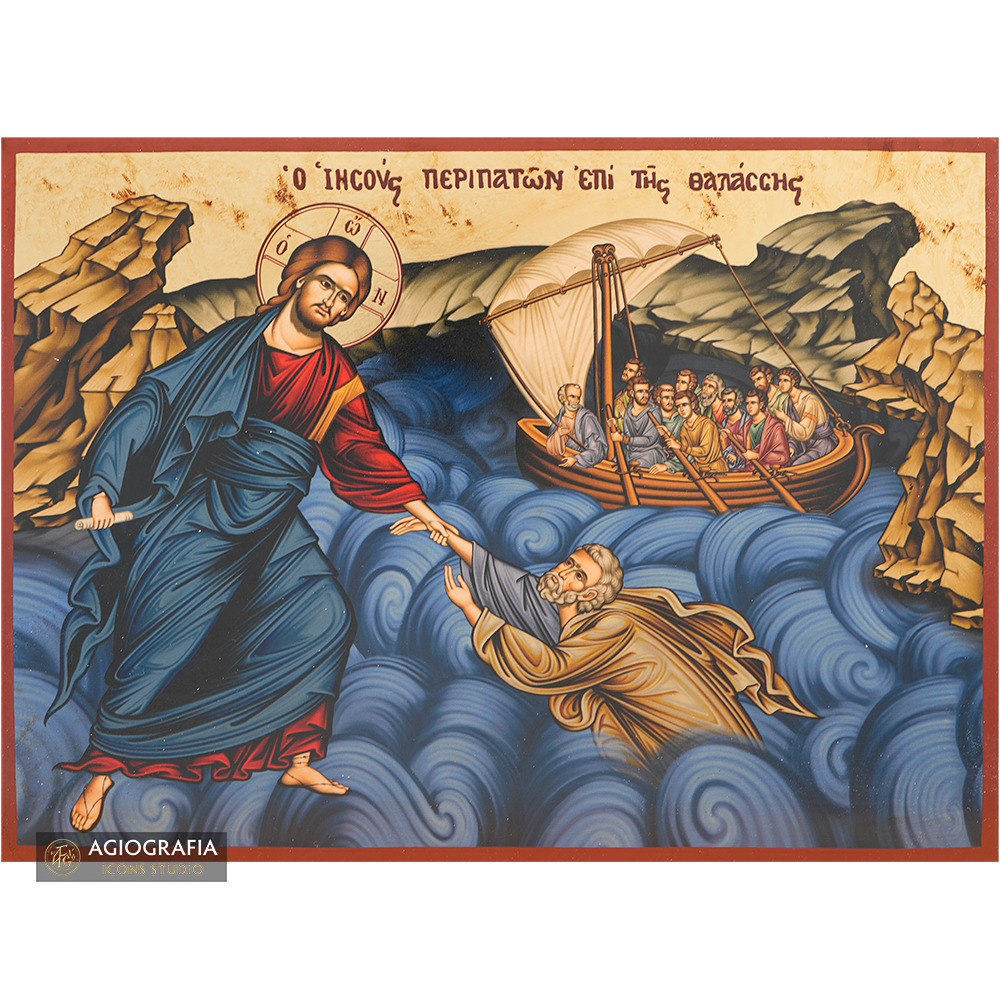
Peter Walked on Water
This may be one of the most overlooked miracles in the entire Gospel.
Everyone remembers that Jesus walked on water.
Far fewer remember that—for a brief moment—
Peter did as well.
Matthew clearly states:
“Then Peter got down out of the boat, walked on the water and came toward Jesus.”
For those few moments, Peter accomplished what human nature alone could never achieve.
Not because he possessed supernatural ability.
Not because the laws of nature had ceased to exist.
But because divine grace was sustaining him.
The Fathers often remind us that holiness is not primarily about human achievement.
It is about cooperation with God’s grace.
Peter’s footsteps upon the water illustrate what becomes possible when a human life is completely directed toward Christ.
The Beginning of Peter’s Fall
Then Matthew records one of the most important verses in the entire passage.
“But when he saw the wind, he was afraid and, beginning to sink…”
Notice the sequence carefully.
He saw the wind.
Then he became afraid.
Then he began to sink.
The wind had been there all along.
The waves had not grown larger.
The circumstances had not changed.
Peter had changed.
His eyes shifted.
Until that moment, his attention had been fixed entirely upon Christ.
Now it became fixed upon the storm.
This is where spiritual decline always begins.
Long before outward failure appears, the heart quietly loses its focus.
Every Christian recognizes this struggle.
Life becomes overwhelming not because God has moved farther away, but because our attention becomes consumed by the waves surrounding us.
The Hand That Never Lets Go
As Peter begins to sink beneath the waves, he no longer speaks with confidence.
His boldness disappears.
His self-confidence vanishes.
He offers one of the shortest prayers found anywhere in Scripture.
“Lord, save me!”
(Matthew 14:30)
Three words.
Nothing more.
No lengthy prayer.
No carefully chosen language.
Simply a desperate cry from the heart.
Throughout the history of the Church, countless Christians have repeated these same words during moments of fear, illness, persecution, grief, and uncertainty.
Sometimes the deepest prayer is also the simplest.
Christ Reaches Out Immediately
Matthew continues with a detail that should never be overlooked.
“Immediately Jesus reached out His hand and caught him.”
(Matthew 14:31)
The word “immediately” is essential.
Christ does not allow Peter to disappear beneath the water.
He does not wait until Peter has learned his lesson.
He does not say,
“Now you understand what happens when you doubt.”
Instead, He stretches out His hand without hesitation.
This reveals the very heart of the Gospel.
God does not delight in human failure.
He delights in human salvation.
Again and again throughout Scripture we encounter the same pattern.
God lifts Adam after the Fall.
He restores David after repentance.
He forgives Peter after his denial.
He welcomes the Prodigal Son.
He rescues Peter from the sea.
Divine mercy always reaches farther than human weakness.
“O You of Little Faith”
Only after saving Peter does Jesus speak.
“O you of little faith, why did you doubt?”
Notice what Christ does not say.
He does not call Peter an unbeliever.
He does not reject him.
He calls him “one of little faith.”
There is faith.
But it is still growing.
Still maturing.
Still learning to trust completely.
The Fathers of the Church point out something beautiful here.
Christ corrects Peter after He saves him.
Mercy comes before correction.
Love comes before instruction.
This is how God deals with every human soul.
He lifts us first.
Then He teaches us how to stand.
When Jesus Enters the Boat
Matthew records another seemingly simple detail.
“And when they climbed into the boat, the wind died down.”
(Matthew 14:32)
The order is significant.
Jesus enters the boat.
Then the storm becomes calm.
The presence of Christ comes before the peace.
This truth remains just as relevant today.
Many people believe peace comes only after every problem disappears.
The Gospel presents another way.
Peace begins with Christ’s presence.
The storm may continue for a time.
Life’s circumstances may remain difficult.
Yet something changes within the human heart.
The believer is no longer facing the storm alone.
“Truly You Are the Son of God”
The passage concludes with one of the most important confessions in the Gospel.
“Truly You are the Son of God.”
(Matthew 14:33)
This is the true purpose of the miracle.
The miracle itself is not the destination.
It is the sign.
Its purpose is to reveal who Jesus truly is.
The One who walks upon the sea is not merely a remarkable teacher.
He is not simply another prophet.
He is the eternal Son of God.
Throughout Scripture, the sea often symbolizes chaos, fear, evil, and the uncontrollable forces of life.
Christ walks over them all.
Nothing stands above Him.
Nothing escapes His authority.
Even the wind and the waves obey their Creator.
What Does This Mean for Us Today?
Nearly two thousand years have passed since that night on the Sea of Galilee.
Yet human hearts remain remarkably unchanged.
Our storms may look different.
They may come in the form of illness.
Financial hardship.
Broken relationships.
Depression.
Anxiety.
War.
Loneliness.
Or the uncertainty of tomorrow.
The Gospel never promises a life without storms.
The disciples themselves experienced persecution, imprisonment, suffering, and martyrdom.
Faith did not remove every trial.
It transformed the way they faced them.
The central message of this passage is therefore not that Christians will avoid suffering.
It is that Christ is present within suffering.
That truth changes everything.
Faith Is Not the Absence of Fear
One of the greatest misunderstandings about Christian faith is the belief that faithful people never experience fear.
The Gospel tells a different story.
The disciples were afraid.
Peter was afraid.
Even after witnessing countless miracles, fear still entered their hearts.
The difference was not that they never struggled.
The difference was where they turned when fear overwhelmed them.
Peter did not save himself.
He cried out to Christ.
Faith is not pretending the storm does not exist.
Faith is choosing to look toward Christ even while the storm continues.
The Boat as an Image of the Church
From the earliest centuries of Christianity, many Church Fathers saw a deeper symbolism in this passage.
The boat represents the Church.
The sea represents the world.
The storm represents temptation, persecution, suffering, and every challenge believers encounter throughout history.
Time and again, the Church has appeared small and vulnerable amid powerful storms.
Empires have risen and fallen.
Persecutions have come and gone.
Wars have shaken nations.
Cultures have changed.
Yet the Church remains.
Not because of human strength.
But because Christ never abandons the boat.
This image offers profound hope.
The same Lord who came to His disciples during the darkest watch of the night continues to guide His Church today.
Conclusion
The account of Jesus walking on the water is far more than the story of an extraordinary miracle.
It is the story of every human heart.
At one time or another, each of us finds ourselves in the middle of a storm.
Each of us knows what it means to struggle against winds beyond our control.
Each of us has experienced moments when fear seems stronger than faith.
The Gospel invites us to remember one simple truth.
Peter did not sink because the waves were too powerful.
He began to sink when his attention shifted from Christ to the storm.
The same temptation confronts every believer.
We can become so focused on our fears that we lose sight of the One who stands above them.
Yet even then, Christ does not abandon us.
He reaches out His hand.
He lifts us.
He calls us back to trust.
And He still speaks the same words that echoed across the waters of Galilee nearly two thousand years ago:
“Take courage! It is I. Do not be afraid.”
Those words were not meant only for frightened fishermen.
They are spoken to every person who has ever faced uncertainty, grief, suffering, or fear.
For as long as Christ is in the boat, no storm has the final word.
About the Author
My name is Stefanos Katrinakis, and I was born and raised in Eastern Crete. For more than 20 years I have worked in tourism, welcoming visitors from around the world while sharing the history, culture and living traditions of my homeland.
Through the Stefanos Tours Travel Blog, I write about Crete’s history, Orthodox heritage, local traditions and authentic experiences, hoping to help visitors discover not only the beauty of the island, but also the values that have shaped its people for centuries.
If you are visiting Crete, you may notice that faith remains an important part of everyday life. Small chapels stand along country roads, monasteries overlook the mountains, and many local traditions continue to reflect centuries of Orthodox Christian heritage. Understanding these traditions offers visitors a deeper appreciation of the island beyond its beaches and landscapes.