
What Is a Greek Panigiri? Understanding the Heart of Greece’s Orthodox Village Festivals
18/07/2026
Greek Moussaka: The Story Behind Greece’s Most Famous Dish
21/07/2026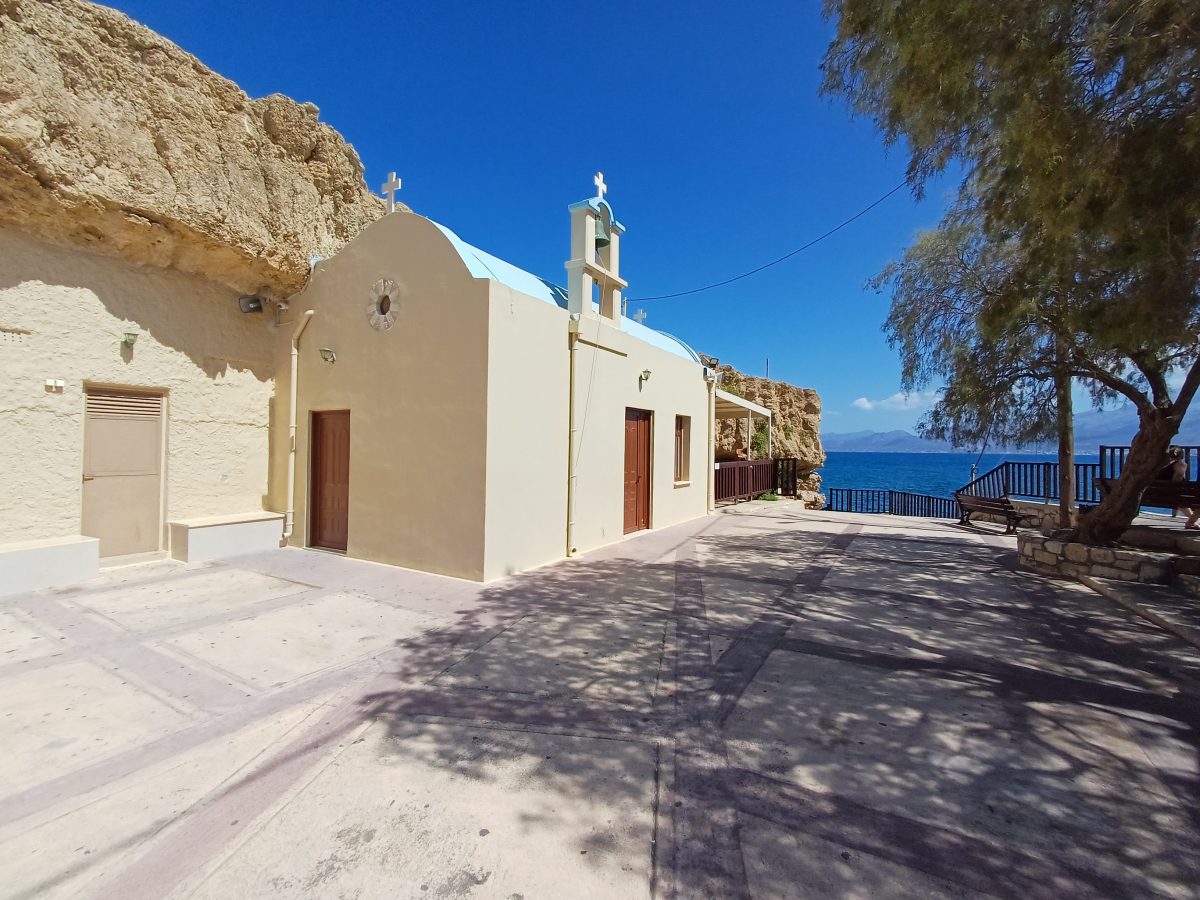
From Minoan sanctuaries and sacred caves to Byzantine monasteries and village chapels, discover how Crete’s spiritual landscape has evolved for more than four millennia.
The Island Where Sacred Places Never Died
Long before magnificent churches crowned Crete’s mountains and before Byzantine monks sought solitude in its caves, the island was already one of the most sacred places in the ancient Mediterranean.
Crete is often celebrated as the birthplace of Europe’s earliest advanced civilisation—the Minoans. Yet beyond their impressive palaces, colourful frescoes and sophisticated cities, the Minoans left behind something even more enduring: a unique relationship with the natural sacred landscape of Crete.
Unlike many ancient cultures that concentrated religious life inside monumental temples, the Minoans often worshipped in nature itself.
Mountain summits, deep caves, freshwater springs, rocky peaks and secluded forests were not simply parts of the landscape. They were places where humans believed they could communicate with the divine.
This idea would shape the spiritual geography of Crete for thousands of years.
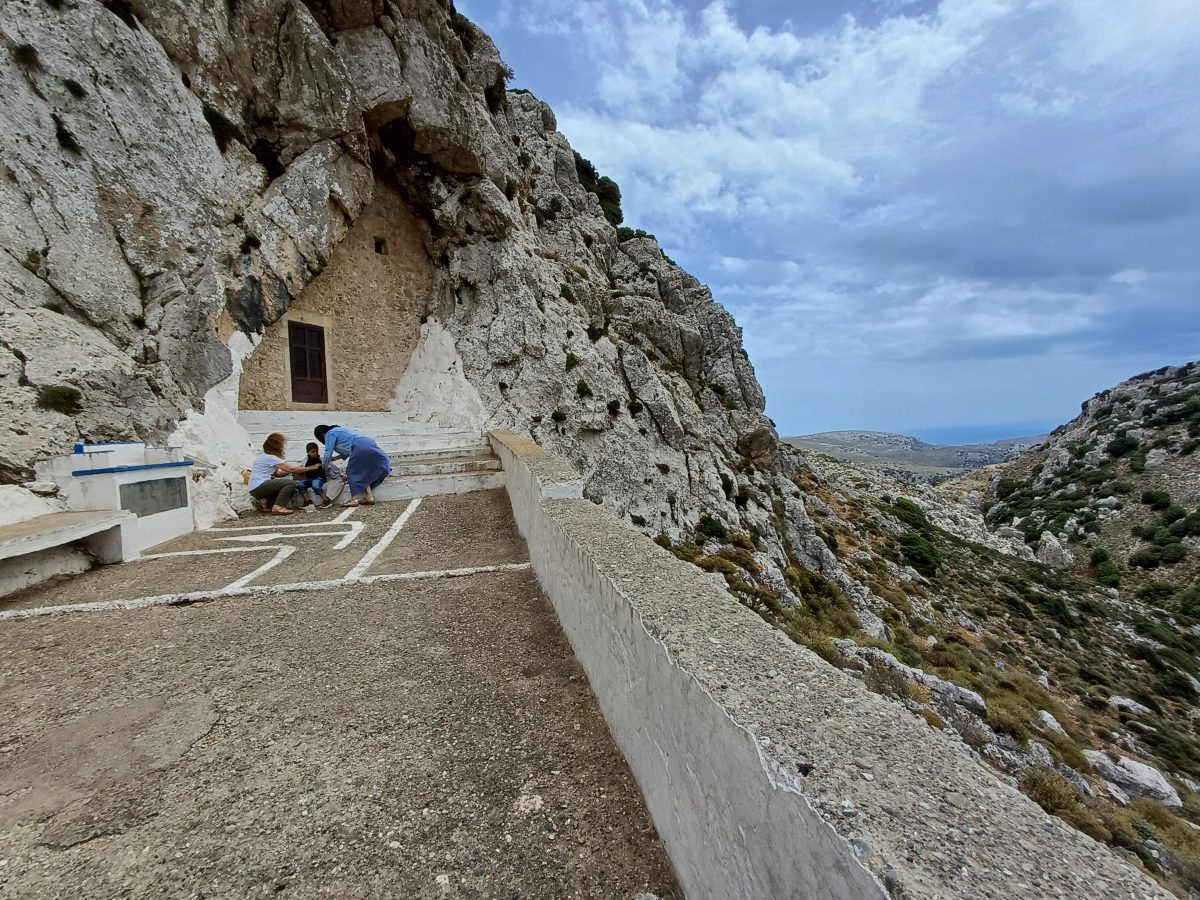
Today, travellers crossing the island quickly notice something remarkable. Small white chapels stand on isolated mountain tops. Tiny churches appear beside ancient springs. Monasteries cling to cliffs, while cave chapels remain places of pilgrimage.
At first glance these locations seem to have been chosen simply because they offer beautiful views or peaceful surroundings.
Archaeology, however, tells a far more fascinating story.
Many of these places had already been regarded as sacred centuries—or even millennia—before Christianity reached Crete. In several cases, excavations have revealed evidence of Bronze Age ritual activity beneath or close to later Christian monuments. Elsewhere, the continuity lies not in a direct architectural succession but in the repeated choice of the same distinctive landscapes as places of worship across different historical periods.
This distinction is important.
A widespread belief claims that Christian churches in Crete were systematically built on top of pagan temples to erase earlier religions. While this certainly happened in some parts of the Mediterranean and there are documented examples in Crete, modern archaeological research paints a much more nuanced picture.
Sometimes a church did replace an older sanctuary.
Sometimes it was built nearby.
Sometimes there is no archaeological connection at all.
And sometimes a sacred mountain or cave simply continued to attract worshippers, even though the object of devotion had changed completely.
Rather than seeing this as a story of destruction or replacement, many historians now describe it as the gradual transformation of a sacred landscape. The physical place remained important, while its religious meaning evolved over time.
Crete offers one of the finest examples of this phenomenon anywhere in Europe.
Few islands possess such an extraordinary concentration of sacred mountains, ritual caves, ancient sanctuaries, early Christian basilicas, Byzantine monasteries and isolated chapels—all woven together across more than four thousand years of continuous human history.
To understand why, we must travel back to a civilisation that flourished nearly two thousand years before the birth of Christ.
A civilisation that looked not toward monumental temples, but toward the mountains, the caves and the living landscape itself.
The story begins with the Minoans.
Before Temples: When Nature Was the First Sanctuary
Long before marble temples rose across the Greek world and centuries before Christianity reached the shores of Crete, the island’s earliest inhabitants had already begun to shape a spiritual relationship with the landscape around them.
To understand why so many churches, monasteries and chapels occupy dramatic locations today, we must first travel back more than five thousand years, to a time before written history, before cities and even before the Minoan civilisation itself.
The First Cretans
The earliest farming communities arrived in Crete during the Neolithic period, around the seventh millennium BC. These settlers transformed the island from a land inhabited only by wildlife into one of the first permanently occupied islands in the Mediterranean.
Unlike later civilisations, they left behind no grand temples or monumental sanctuaries. Instead, archaeologists believe that religious life was closely intertwined with the rhythms of nature. Mountains dominated the horizon, caves offered shelter and mystery, springs provided life-giving water, and the changing seasons determined survival.
For these early communities, the landscape itself was sacred.
Although written records do not exist from this period, archaeological discoveries suggest that caves were already used for ritual activities long before the rise of the Minoan civilisation. Objects deliberately deposited inside caves, traces of communal gatherings and symbolic artefacts indicate that these natural spaces served purposes extending beyond everyday life.
This pattern would become one of the defining characteristics of Cretan religion for thousands of years.
Why Mountains Inspired Reverence
Crete is unlike almost any other Mediterranean island.
Three great mountain ranges dominate its landscape: the White Mountains (Lefka Ori), Mount Ida (Psiloritis) and the Dikti Mountains. Rising dramatically above the sea, they create an island where nearly every settlement lives under the presence of towering peaks.
For prehistoric people, mountains were more than geographical features.
They were places where earth met sky.
The higher one climbed, the further one moved away from the ordinary world and closer to the realm of the divine.
This symbolism appears repeatedly in ancient cultures across the world, but in Crete it assumed a distinctive form. During the Minoan period, dozens of mountain summits became organised places of worship, now known as peak sanctuaries.
The remarkable fact is that many of these same summits later became home to small Christian chapels, especially those dedicated to the Prophet Elijah (Profitis Ilias). Although there is rarely evidence of a direct architectural continuity, the repeated choice of these commanding heights suggests that certain places retained a powerful spiritual attraction across different religious traditions.
Caves: The Womb of the Earth
If mountains represented closeness to the heavens, caves embodied mystery and the hidden forces of the earth.
Dark, cool and often containing underground water, caves inspired awe in prehistoric societies throughout the Mediterranean. In Crete they became central to religious life.
Long before they were associated with Christian hermits and chapels, caves functioned as places of ritual, pilgrimage and offerings. The famous Dikteon Cave and Idaean Cave would later become linked in Greek mythology with the birth and upbringing of Zeus, yet archaeological excavations reveal that both had already been important ritual sites during the Bronze Age.
This illustrates one of the central themes of Cretan history: religious traditions changed, but many sacred places continued to attract devotion.
A Landscape Waiting for Civilisation
By the beginning of the Bronze Age, the foundations of Crete’s sacred geography had already been laid.
Mountains inspired pilgrimage.
Caves invited worship.
Springs symbolised life.
Prominent hills became places of gathering.
When the Minoan civilisation emerged around 3000 BC, it did not invent these sacred landscapes from nothing. Instead, it inherited, developed and transformed traditions that had already existed for generations.
The magnificent peak sanctuaries, cave shrines and ritual centres of the Minoans were therefore not isolated creations. They represented the next stage in a much longer story—one that would continue through Greek, Roman, Byzantine and modern Crete.
The sacred landscape of the island had begun to take shape.
Its evolution had only just started.
The Minoan Sacred Landscape: Mountains, Caves and the First Pilgrims of Europe
When people think of the Minoan civilisation, they usually imagine the grand palace of Knossos, colourful frescoes, elegant pottery and the legendary King Minos.
Yet surprisingly, the greatest temples of the Minoans were often not buildings at all.
Their most sacred places were created by nature itself.
Across Crete, archaeologists have identified more than forty peak sanctuaries—shrines built on mountain summits overlooking the surrounding countryside. Others may still await discovery. These remarkable sites, unique to Minoan Crete, flourished mainly during the Middle and Late Bronze Age and formed one of the defining features of Minoan religion.
Unlike the enclosed temples of Egypt or Mesopotamia, Minoan peak sanctuaries were open to the sky. Pilgrims climbed steep mountain paths carrying clay figurines, miniature animals, vessels and other offerings. At the summit they gathered for ceremonies that remain only partly understood, leaving behind thousands of votive objects that archaeologists continue to study today.
Although no written text explains these rituals in detail, the archaeological evidence reveals that the climb itself was probably an important part of the religious experience. Reaching the summit required effort, preparation and intention. The journey may have symbolised moving from the ordinary human world into a space perceived as especially close to the divine.
Why Mountains?
The location of these sanctuaries was anything but random.
Most occupy commanding peaks visible from large areas of surrounding farmland and settlements. From these summits, worshippers could overlook the land that sustained their communities while remaining visually connected to neighbouring sacred sites.
This network of mountain sanctuaries may also have reinforced social cohesion. Communities living in different valleys could see the same sacred peak rising above the landscape, creating a shared religious identity that transcended individual villages.
For the Minoans, geography was not simply physical.
It was spiritual.
The Peak Sanctuaries of Crete
Among the best-known examples are:
- Mount Juktas, south of Knossos, perhaps the most important peak sanctuary of Minoan Crete. Ancient tradition later associated the mountain with the tomb of Zeus because its silhouette resembles a reclining human face.
- Petsofas, overlooking Palaikastro in eastern Crete, where excavations uncovered thousands of clay human and animal figurines, many representing worshippers seeking healing or divine protection.
- Traostalos, near Zakros, controlling one of the easternmost regions of the island.
- Vrysinas, near modern Rethymno, where evidence suggests long-term ritual activity extending across several centuries.
Each sanctuary possessed its own local character, yet together they formed a remarkable religious network unlike anything else in Bronze Age Europe.
Sacred Caves: Entering the World Below
If mountains brought people closer to the heavens, caves drew them into the mysterious depths of the earth.
Crete contains hundreds of caves, but only some became centres of ritual activity. Archaeological excavations have uncovered pottery, bronze objects, figurines, libation vessels and other offerings deposited over many generations.
Among the most famous are the Dikteon Cave on the Lassithi Plateau and the Idaean Cave on Mount Psiloritis. Both later became inseparably linked with the myth of Zeus. According to Greek tradition, one was the birthplace of the king of the gods, while the other was the cave where he was raised in secret.
Yet archaeology tells an even older story.
Long before Classical mythology developed, both caves had already served as places of worship during the Bronze Age. This demonstrates one of the most fascinating patterns in Cretan religious history: myths, religions and rituals changed, but certain places retained their sacred significance over extraordinarily long periods.
Unlike many ancient civilisations that concentrated worship within monumental architecture, Minoan religion remained deeply connected to the natural world.
Mountains, caves, springs, trees and open-air sanctuaries formed an integrated sacred landscape rather than isolated religious monuments.
This close relationship with nature may explain why some of these places continued to attract spiritual devotion long after the Minoan civilisation disappeared. The holiness of the landscape proved more enduring than the beliefs of any single era.
Thousands of years later, Christian chapels would rise on many of the same mountain ridges, hermits would seek solitude in ancient caves and monasteries would flourish near springs that had sustained communities since prehistoric times.
The gods had changed.
The landscape had not.
Archaeological Perspective
Modern archaeology supports the existence of a widespread network of Minoan peak sanctuaries and cave shrines across Crete. However, it is important to distinguish between continuity of place and continuity of religion. In many cases, there is no evidence that Christian communities intentionally built churches directly over Minoan sanctuaries. What the archaeological record does demonstrate is that certain landscapes—high mountains, caves and springs—continued to be regarded as spiritually meaningful across successive historical periods. This distinction is fundamental to understanding the religious history of Crete and avoids the simplistic narrative that one faith merely replaced another.
The Sacred landscape of Crete When Christianity First Arrived in Crete
“The story of Crete’s churches does not begin with stone buildings. It begins with a voyage across the Mediterranean.”
During the first century AD, Crete stood at the crossroads of the Roman Empire.
Merchant ships connected its harbours with Alexandria, Ephesus, Corinth and Rome. Ideas travelled as quickly as goods, and among them was a new faith that would eventually transform the island forever.
Christianity did not arrive in Crete through conquest.
It arrived through preaching.
Saint Paul and the Island of Crete
The earliest written reference to Christianity in Crete comes from the New Testament itself.
After his release from his first imprisonment in Rome, the Apostle Paul is believed to have travelled once again through the eastern Mediterranean. Although the exact chronology of these journeys remains debated, one fact is clear from the New Testament: Paul regarded Crete as an important mission field.
In his Epistle to Titus, he writes:
“The reason I left you in Crete was that you might put in order what was left unfinished and appoint elders in every town, as I directed you.”
(Titus 1:5)
This single sentence is one of the most significant historical texts concerning early Christianity in Crete.
It tells us three important things.
First, Christian communities already existed on the island.
Second, they required organisation.
Third, Titus had been entrusted with establishing a structured Church throughout Crete.
This is remarkable.
Within only a few decades of Christ’s crucifixion, Christianity had already spread across one of the largest islands in the Mediterranean.
Saint Titus: The First Bishop of Crete
According to Christian tradition, Titus became the first Bishop of Crete.
Born a Gentile and later converted by Saint Paul, he emerged as one of the Apostle’s closest companions.
His mission on the island was not simply to preach.
He was entrusted with organising Christian communities, appointing clergy and strengthening believers scattered throughout Crete’s towns and villages.
For this reason, the Orthodox Church honours Saint Titus as the Apostle of Crete.
His legacy remains visible today.
The impressive Church of Saint Titus in Heraklion preserves this memory, while the ruins of the great Basilica of Saint Titus at Gortyn testify to the importance his name acquired in the centuries that followed.
Whether every tradition associated with Titus can be confirmed archaeologically is another matter. Historians distinguish carefully between what is supported by written and material evidence and what belongs to later ecclesiastical tradition. Yet there is broad agreement that Christianity established deep roots in Crete at a remarkably early date.
A Different Kind of Sacred Space
The arrival of Christianity did not immediately transform the island’s landscape.
The first Christians possessed no monumental cathedrals.
They met in private homes.
Small gatherings.
Simple rooms.
Shared meals.
Prayer.
Scripture.
Community.
Only after Christianity was legalised in the fourth century did large churches begin to appear across Crete.
This is an important point.
Many visitors imagine that Christian monuments appeared overnight.
In reality, the earliest generations of Christians worshipped quietly, often without permanent public buildings.
The sacred community came before the sacred architecture.
A Faith Begins to Reshape the Island
During the following centuries, Crete gradually became one of the most important Christian centres of the eastern Mediterranean.
Dozens of bishops are known from historical records.
Magnificent basilicas were constructed.
Pilgrims travelled across the island.
Monasteries would later emerge in remote valleys and mountain landscapes.
Yet the builders of these churches were faced with an interesting choice.
Where should these new places of worship stand?
Should entirely new sacred places be created?
Or should Christianity become rooted in landscapes that generations of Cretans had already regarded as special?
The answer would shape the religious geography of Crete for the next sixteen centuries.
And it is here that archaeology begins to reveal one of the island’s most fascinating stories.
Archaeological Perspective
The mission of Saint Paul and Saint Titus is supported primarily by the New Testament and the early Christian tradition. The Epistle to Titus provides direct textual evidence that organised Christian communities existed in Crete during the first century AD. However, many details of Titus’ later life derive from ecclesiastical tradition rather than contemporary historical records. Archaeological evidence for Christianity becomes much richer from the fourth century onwards, when large basilicas, inscriptions and episcopal centres begin to appear across the island.
Why Were Some Churches Built on Ancient Sacred Sites?
“The answer is more fascinating than the popular myth.”
Perhaps no subject in the religious history of Crete has generated more misunderstandings than the relationship between ancient pagan sanctuaries and Christian churches.
Visitors often hear a simple explanation:
“When Christianity arrived, churches were built directly on top of pagan temples.”
Although this did happen in some places, the archaeological evidence shows that the reality was far more complex.
Crete does not tell a story of systematic replacement.
It tells a story of adaptation.
Sacred Places Are Older Than Religions
One of the most important concepts in modern archaeology is that people often become attached not merely to a religion but to a place.
Long before a temple is constructed, a mountain may already inspire awe.
A spring may already attract ritual gatherings.
A cave may already be regarded as mysterious.
When beliefs change, these places do not suddenly lose their meaning.
Instead, new generations often reinterpret them through the beliefs of their own time.
This process can be observed across many parts of the Mediterranean, but Crete provides particularly striking examples because its sacred landscapes have remained visible for more than four thousand years.
Four Different Patterns
Archaeologists generally recognise several different ways in which Christianity became established within older sacred landscapes.
1. Direct Reuse
In some locations, churches were constructed directly over or within earlier sanctuaries.
Sometimes this happened because the existing foundations offered practical building material.
Sometimes it symbolised the establishment of the new faith in a place already familiar to local communities.
These cases exist.
But they are not universal.
2. Building Nearby
In many other locations, churches stand close to ancient sanctuaries rather than directly above them.
This distinction is important.
The surrounding landscape may have retained its sacred character even though the exact location of worship shifted.
3. Shared Sacred Landscapes
Perhaps the most common pattern in Crete is not architectural continuity but landscape continuity.
A mountain that attracted Bronze Age pilgrims later received a Byzantine chapel.
A cave once associated with ancient ritual became the retreat of Christian hermits.
A spring linked with older traditions became an agiasma—a holy spring—within Christian devotion.
The sacred place endured even though its meaning changed.
4. Completely New Christian Foundations
Not every church in Crete has a pagan past.
Many churches and monasteries were founded in locations chosen for entirely Christian reasons:
- solitude,
- access to water,
- agricultural land,
- defensive position,
- proximity to settlements,
- or the wishes of a local benefactor.
Assuming that every church replaced an ancient sanctuary is simply not supported by archaeological evidence.
Why Did Certain Places Remain Sacred?
The answer lies in human memory.
People develop emotional and cultural relationships with landscapes over many generations.
Certain places become associated with hope, protection, healing or encounters with the divine.
When a new religion arrives, it often finds these places already embedded within local identity.
Rather than erasing them completely, it may reinterpret them.
The sacred mountain becomes associated with a Christian saint.
The cave becomes a hermitage.
The spring becomes blessed water.
The physical landscape remains.
Its spiritual meaning evolves.
The Cretan Landscape as a Living Archive
This long continuity is one of Crete’s greatest treasures.
Walking across the island today means crossing layer upon layer of religious history.
A visitor may admire a small white chapel without realising that the hill beneath it was already considered special thousands of years earlier.
Likewise, a cave visited by Christian pilgrims may once have echoed with entirely different prayers during the Bronze Age.
The remarkable feature of Crete is not that one religion simply replaced another.
It is that the island preserved an extraordinary continuity of sacred landscapes while allowing successive generations to express their faith in new ways.
Understanding this continuity transforms the way we experience Crete.
Its churches are no longer isolated monuments.
They become the latest chapter in a story that began long before the first cross was ever raised on the island.
Archaeological Perspective
Modern scholarship increasingly distinguishes between architectural continuity and landscape continuity. While some Christian churches were indeed established on or adjacent to earlier sanctuaries, there is no archaeological basis for claiming that this occurred systematically across Crete. The strongest evidence instead supports the idea that mountains, caves, springs and other prominent natural features retained their importance as sacred places across different historical periods, even though the beliefs and rituals associated with them changed significantly over time.
Mountains That Never Lost Their Holiness
There is a moment that almost every visitor to Crete experiences without fully understanding it.
As you drive across the island, your eyes are repeatedly drawn to tiny white chapels standing alone on distant mountain summits.
Some appear no larger than a single room.
Others cling dramatically to rocky ridges where no village exists for miles.
Many bear the same name:
Profitis Ilias — the Prophet Elijah.
Why would hundreds of churches dedicated to the same saint be built on the highest mountains of Crete?
The answer reaches far deeper than Christian tradition alone.
The Sacred Summit
For prehistoric communities, mountains represented far more than elevated ground.
They dominated the horizon.
They attracted rain.
They controlled rivers.
They determined agriculture.
They offered protection.
Most importantly, they appeared to connect earth with the heavens.
Across many ancient cultures, the highest places naturally became places where humans sought contact with the divine.
Crete was no exception.
Long before Christianity arrived, people climbed its mountains carrying offerings to gods whose names we may never know.
The archaeological remains of Minoan peak sanctuaries reveal that these ascents were deliberate acts of worship rather than ordinary journeys.
Reaching the summit required effort.
The climb itself formed part of the ritual.
Even today, anyone who walks to one of Crete’s mountain chapels experiences something similar.
The silence.
The wind.
The vast panorama.
The feeling of leaving ordinary life behind.
Although separated by thousands of years, the emotional experience is surprisingly familiar.
Why the Prophet Elijah?
One question still puzzles many visitors.
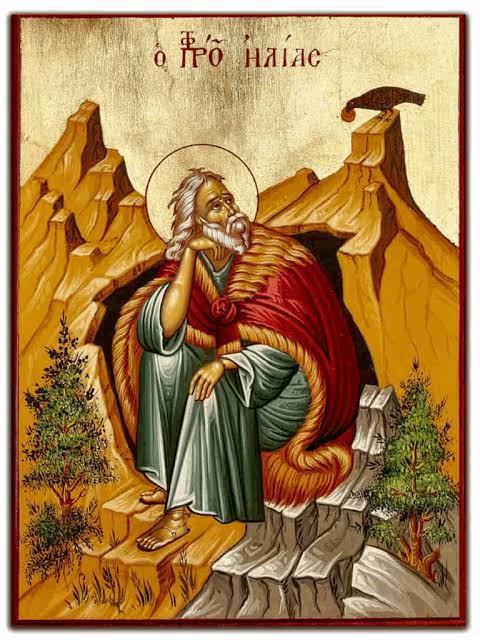
If these mountains had long been regarded as sacred, why are so many summit chapels dedicated specifically to the Prophet Elijah?
The answer lies partly in Christian tradition and partly in linguistic coincidence.
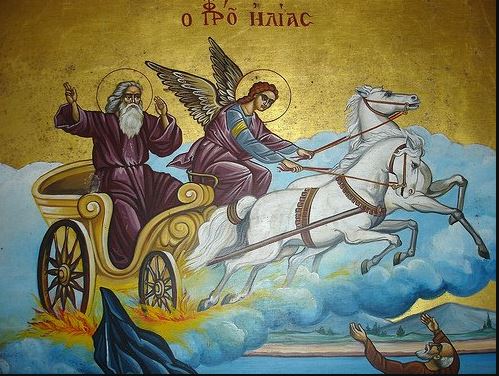
According to the Old Testament, the Prophet Elijah was taken into heaven in a fiery chariot rather than experiencing death in the ordinary human way.
Because of this close association with heaven, high places naturally became linked with his memory throughout the Orthodox world.
In Greece, another factor may also have influenced this tradition.
Some historians have suggested that the similarity between the names Helios (the ancient sun god) and Ilias (Elijah) may have encouraged the dedication of former high places of worship to the Prophet. This idea remains debated and should be treated as a scholarly hypothesis rather than an established fact. There is no evidence that this happened everywhere, but it illustrates how language and cultural memory can sometimes influence religious traditions.
What is certain is that, by the Byzantine period, mountain summits across Crete had become closely associated with the Prophet Elijah.
A Tradition That Continues
Every summer, especially around 20 July, thousands of Cretans still climb mountain paths before sunrise.
Some walk for hours.
Families gather.
Priests celebrate the Divine Liturgy.
Food is shared.
Old friendships are renewed.
Children run among the rocks while bells echo across the valleys below.
To an outside observer, this may seem like a simple village feast.
Yet viewed through the lens of history, it represents something much deeper.
People are still climbing the mountains.
They are still gathering on the highest peaks.
They are still seeking God in places where generations before them also looked toward the heavens.
The prayers have changed.
The destination has not.
Looking Across Four Thousand Years
Imagine standing today outside a small chapel dedicated to the Prophet Elijah.
The whitewashed walls belong to the modern world.
The cross above the roof speaks of Christianity.
The ringing bell calls the faithful to prayer.
But beneath your feet lies a mountain that may have witnessed pilgrims since the Bronze Age.
Different languages.
Different religions.
Different civilizations.
One enduring landscape.
This is perhaps the greatest lesson that Crete offers.
Sacredness is not always preserved by buildings.
Sometimes it is preserved by the land itself.
Archaeological Perspective
Many of Crete’s mountain chapels occupy prominent summits that also hosted prehistoric or ancient ritual activity, but each site must be assessed individually. Archaeologists caution against assuming a direct line of continuity without evidence. The broader pattern, however, is clear: elevated landscapes have repeatedly been selected for religious purposes from the Bronze Age to the present, making the mountains themselves one of the strongest expressions of Crete’s enduring sacred geography.
CHAPTER 8
Sacred Caves: From the Birthplace of Zeus to the Hermit Saints
“If Crete’s mountains brought people closer to the heavens, its caves invited them into the hidden mysteries of the earth.”
Few places reveal the remarkable continuity of Crete’s sacred landscape more clearly than its caves.
Scattered across the island are more than 3,000 recorded caves and rock shelters, ranging from tiny crevices hidden among olive groves to vast underground chambers stretching deep beneath the mountains. Only a small number became places of worship, yet those that did remained spiritually significant for thousands of years.
Today, many visitors enter these caves simply to admire their spectacular stalactites and stalagmites.
Few realise they are walking into some of Europe’s oldest places of pilgrimage.
The First Sacred Caves
Long before the first churches were built, caves occupied a unique place in the spiritual imagination of prehistoric Cretans.
Unlike mountains, which reached toward the sky, caves descended into darkness.
They concealed underground springs.
They echoed with mysterious sounds.
Their cool temperatures contrasted sharply with the Mediterranean sun.
To early communities, they seemed to belong to another world.
Archaeological excavations have uncovered clay vessels, bronze objects, figurines, weapons, jewellery and animal offerings carefully deposited inside several Cretan caves over many centuries.
These were not accidental losses.
They were deliberate acts of devotion.
Some caves functioned as local shrines serving nearby communities.
Others attracted pilgrims from much greater distances, becoming regional centres of worship during the Bronze Age.
The Cave of Zeus
No cave in Crete is more famous than the Dikteon Cave, situated high above the Lassithi Plateau.
According to later Greek mythology, this was the place where Rhea hid the infant Zeus from his father Cronus.
Protected by the Curetes, whose shields drowned out the baby’s cries, Zeus was raised in secrecy before becoming king of the Olympian gods.
Whether mythology reflects distant memories of Bronze Age beliefs cannot be proven.
What archaeology has demonstrated, however, is equally fascinating.
Excavations reveal that the cave had already been used continuously for ritual activity long before these myths were first recorded.
Pilgrims left offerings there for centuries.
The myth came later.
The sacredness of the place came first.
From Pagan Sanctuary to Christian Hermitage
With the spread of Christianity, caves acquired an entirely different meaning.
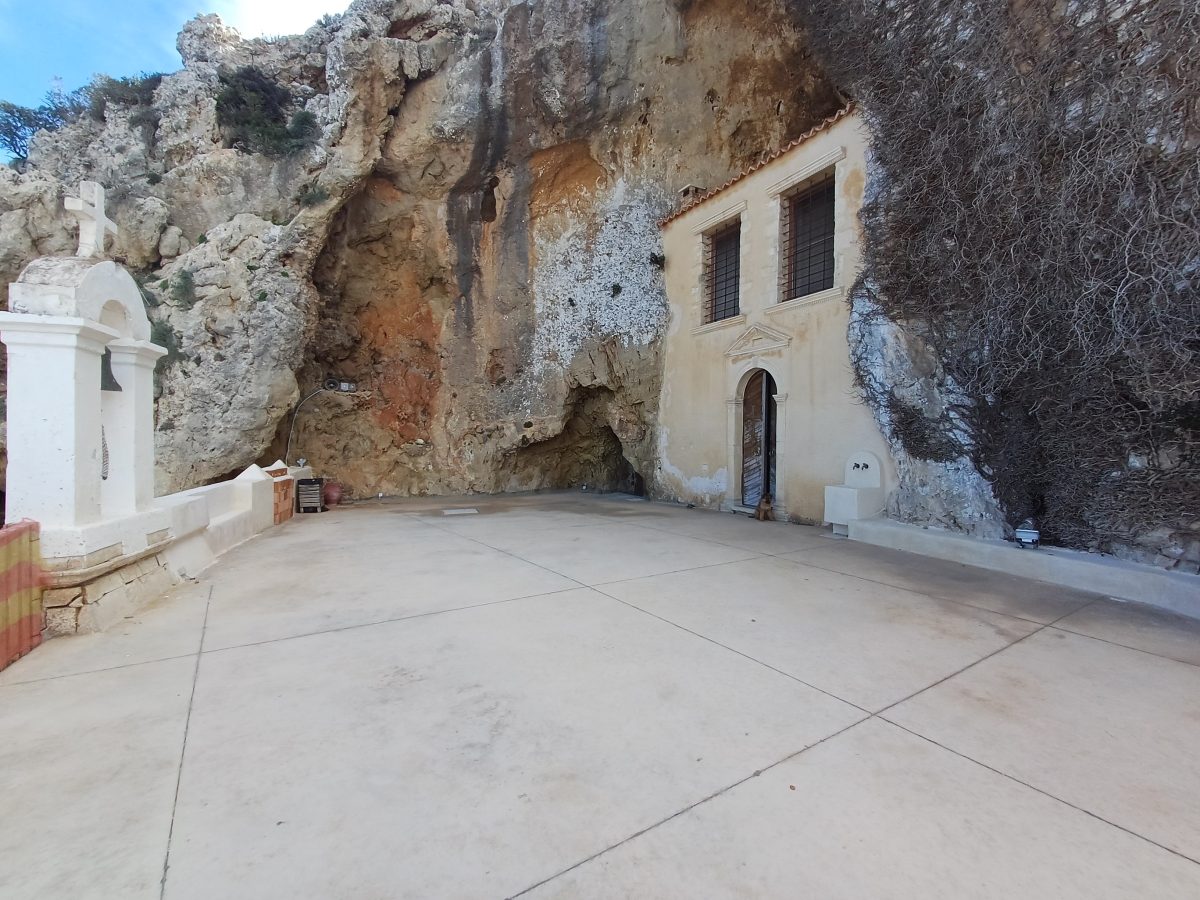
Instead of serving as places where offerings were made to ancient deities, many became homes for hermits seeking silence, solitude and prayer.
Throughout Crete, monks withdrew into remote caves to imitate Christ’s forty days in the wilderness.
Some spent decades living in extraordinary isolation.
Others attracted disciples, eventually giving rise to chapels and monasteries built nearby.
The cave itself remained the centre of spiritual life.
Only its purpose had changed.
Caves as Living Places of Worship
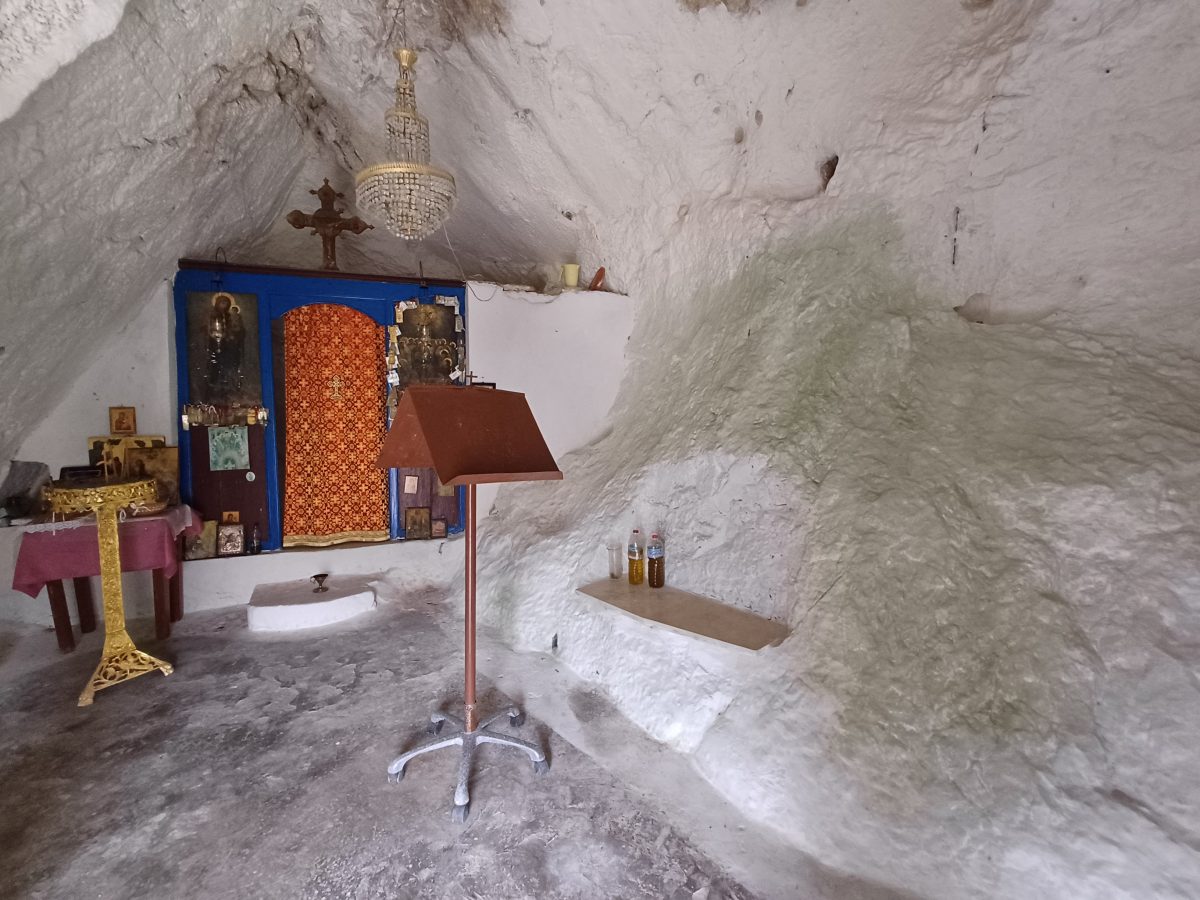
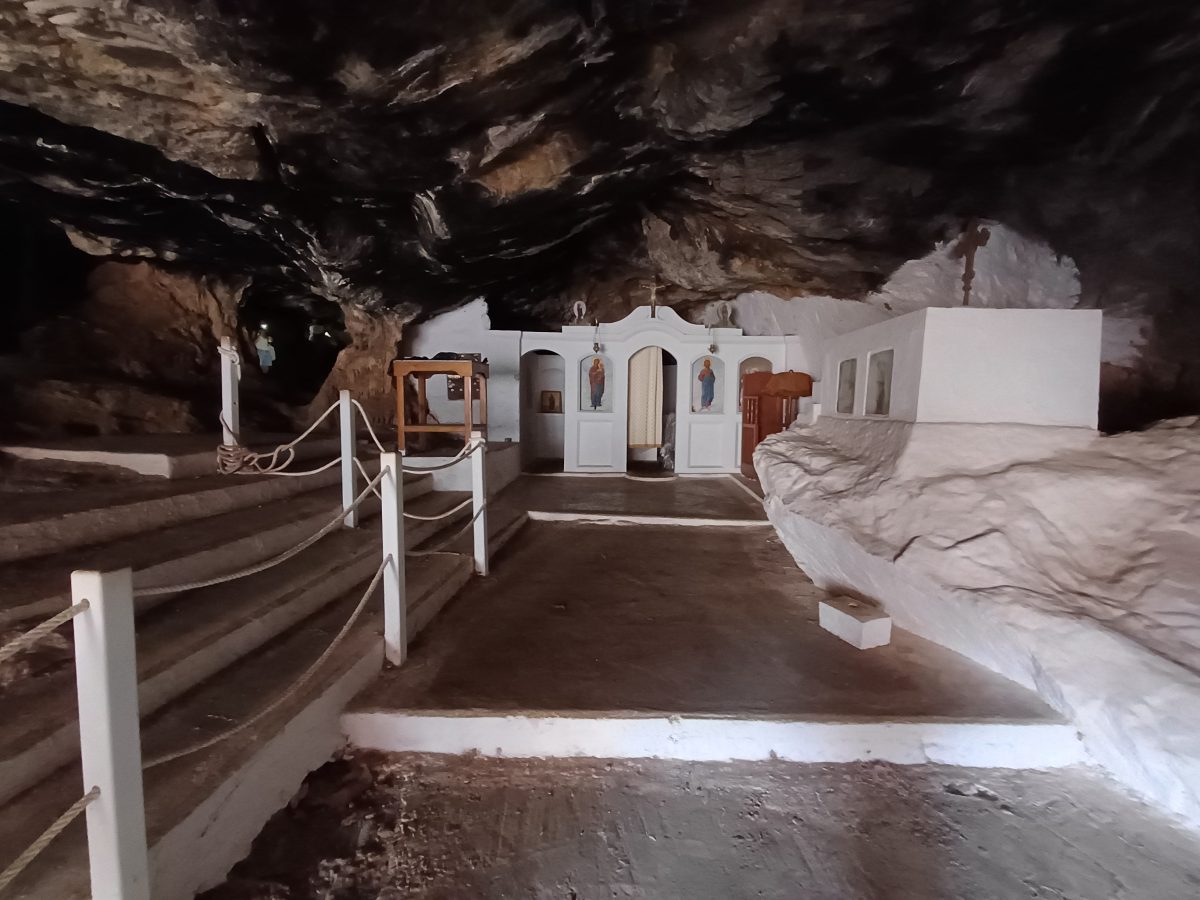
Unlike many archaeological sites that became abandoned ruins, several sacred caves of Crete continue to function as places of Christian devotion today.
Small chapels built within cave entrances still host feast-day celebrations.
Candles flicker beneath ancient rock formations.
Pilgrims continue to pray where people gathered thousands of years earlier.
Although separated by entirely different beliefs, these generations share one remarkable characteristic.
They recognised the same landscape as a place where the ordinary world seemed to give way to something greater.
Why Caves Never Lost Their Power
Perhaps this explains why caves occupy such a unique position within Crete’s sacred geography.
Unlike buildings, caves cannot be constructed or destroyed by human hands.
They are timeless.
Empires rise and disappear.
Religions change.
Languages evolve.
Yet the cave remains exactly where nature placed it.
Generation after generation, people have entered these silent spaces searching for protection, healing, wisdom or simply the presence of God.
The prayers changed.
The silence never did.
Archaeological Perspective
Archaeological evidence confirms that several Cretan caves—including the Dikteon and Idaean caves—were major ritual centres from the Bronze Age onward. Their later association with Greek mythology reflects the reinterpretation of already sacred places rather than the beginning of their religious significance. During the Christian era, numerous caves were reused as hermitages or cave chapels, illustrating once again the distinction between continuity of sacred place and continuity of religious practice. This pattern is one of the clearest examples of Crete’s long-lived sacred landscape.
Sacred Springs: Water, Healing and the Birth of Holy Wells
“Where there is life, there is water. Where there is water, people often discover the sacred.”
Across Crete, fresh water has always been precious.
An island of rugged mountains, dry summers and seasonal rivers could never take its springs for granted. Long before aqueducts, reservoirs and modern plumbing, natural springs sustained villages, travellers, shepherds and entire civilizations.
It is hardly surprising that many of these life-giving places also became places of worship.
For thousands of years, the people of Crete have associated fresh water not only with survival, but with purification, healing and divine blessing.
Water in the Minoan World
The Minoans understood the importance of water both practically and spiritually.
Archaeologists have identified ritual basins, lustral areas and carefully designed water systems within major palaces such as Knossos, Phaistos and Zakros. Although scholars continue to debate the exact religious function of every structure, there is broad agreement that water played a significant symbolic role in Minoan ritual life.
Springs themselves were often regarded as special places where the natural and the divine seemed to meet.
Many were located near caves, sacred groves or mountain sanctuaries, reinforcing the close relationship between landscape and religion.
The Greek and Roman Tradition
As Greek religion developed in Crete, springs continued to occupy an important place in mythology.
Across the Greek world, sacred fountains were associated with nymphs, healing deities and local heroes. Water was believed to cleanse both body and soul before entering certain sanctuaries.
During the Roman period, this tradition continued.
Many healing sanctuaries were built near reliable springs, where visitors sought physical recovery as well as spiritual comfort.
Again, the exact beliefs evolved.
The importance of the place remained.
Christianity and the Sanctification of Water
Christianity did not abandon the symbolism of water.
Instead, it transformed its meaning.
Water became inseparably linked with baptism—the sacrament through which believers entered the Christian life.
At the same time, many natural springs gradually became associated with saints, monasteries and local traditions of healing.
Throughout Crete, pilgrims began visiting what are now known as holy wells or agiasmata—springs believed to have received God’s blessing through the prayers of saints or through long-standing traditions of devotion.
People came seeking healing, strength and hope.
Some still do today.
The Living Tradition of Agiasmata
One of the most remarkable aspects of Crete’s sacred springs is that they remain active places of pilgrimage.
Visitors may drink the water, wash their hands or face, light a candle in the nearby chapel or simply sit quietly beneath the shade of ancient trees.
Whether or not one believes in miraculous healing, these places continue to offer something deeply human:
peace.
Unlike archaeological monuments preserved behind barriers, sacred springs remain woven into everyday religious life.
Local people continue to care for them.
Feast days are still celebrated.
Stories are still passed from one generation to the next.
Why Springs Endure
There is a simple reason why sacred springs have survived for so many centuries.
People cannot live without water.
Every settlement depended upon it.
Every traveller searched for it.
Every shepherd knew where to find it.
Because these places were essential to daily life, they naturally became places where communities gathered.
Religion followed the people.
Over time, the spring became more than a source of water.
It became a source of memory.
Continuity Without Sameness
It would be misleading to suggest that every Christian holy spring in Crete directly replaced an ancient pagan sanctuary.
Archaeology does not support such a sweeping conclusion.
What the evidence does suggest is something more subtle and perhaps more interesting.
Communities repeatedly recognised the spiritual significance of the same natural features.
A spring that sustained life in prehistoric times could later become associated with a local saint.
The landscape remained constant.
Its religious interpretation evolved.
This distinction lies at the heart of Crete’s sacred geography.
Archaeological Perspective
Natural springs have attracted human settlement and ritual activity since prehistoric times. Although direct continuity between individual prehistoric cult sites and Christian holy wells cannot always be demonstrated, archaeological and historical evidence shows that springs consistently occupied a privileged place within Cretan religious life. Their enduring significance illustrates one of the central themes of this article: the continuity of sacred landscapes, even as beliefs, rituals and religious identities changed across the centuries.
Saints Who Shaped the Sacred Landscape of Crete
“A sacred landscape is not created by nature alone. It is also shaped by the lives of those who choose to dedicate themselves to God.”
Mountains, caves and springs may have formed the physical setting of Crete’s sacred geography, but it was the island’s saints, monks and missionaries who transformed that landscape into a living Christian tradition.
From the first century to the present day, generations of believers have left their mark on Crete—not by building great cities or conquering kingdoms, but by establishing churches, monasteries and places of prayer that continue to inspire pilgrims today.
Saint Titus: Bringing Christianity to Crete
According to the New Testament, Saint Paul entrusted his disciple Saint Titus with organising the Church in Crete.
The Epistle to Titus presents him as the island’s first bishop, responsible for strengthening the newly established Christian communities.
While archaeology cannot reconstruct every detail of his ministry, Christian tradition has regarded Saint Titus for nearly two thousand years as the spiritual founder of the Cretan Church.
His legacy is still visible today in churches dedicated to his memory, particularly in Heraklion, where the Church of Saint Titus remains one of the island’s most important places of worship.
The Age of the Hermits
As Christianity spread across the Eastern Mediterranean, many believers sought a life of silence and prayer away from cities.
Crete’s rugged mountains and remote caves offered the perfect environment.
Hermits settled in isolated valleys, mountain shelters and sea cliffs, dedicating themselves to prayer, fasting and contemplation.
Some remained unknown except to God.
Others became revered as holy men whose wisdom attracted disciples and pilgrims.
Over time, small hermitages grew into chapels, and chapels eventually became monasteries.
The landscape itself became a map of Christian devotion.
Saint John Xenos
Among the most influential monastic figures in medieval Crete was Saint John Xenos (c. 970–1035).
Travelling across the island during the Byzantine period, he restored old churches, founded monasteries and encouraged spiritual renewal at a time when many religious institutions had fallen into decline.
Several monasteries traditionally associated with him continue to stand today, preserving both their architectural heritage and their role as centres of Orthodox worship.
His life demonstrates that the sacred landscape of Crete was never static.
Each generation contributed to it.
Monasteries as Centres of Faith and Culture
The monasteries established throughout Crete served purposes far beyond religious worship.
They became centres of education, manuscript production, hospitality and charitable work.
During periods of foreign rule—including the Venetian and Ottoman eras—many monasteries also played an important role in preserving the Greek language, Orthodox faith and local identity.
For countless Cretans, the monastery was not simply a religious building.
It was the heart of the community.
Saints in Everyday Life
One of the distinctive features of Crete is the close relationship between local communities and their patron saints.
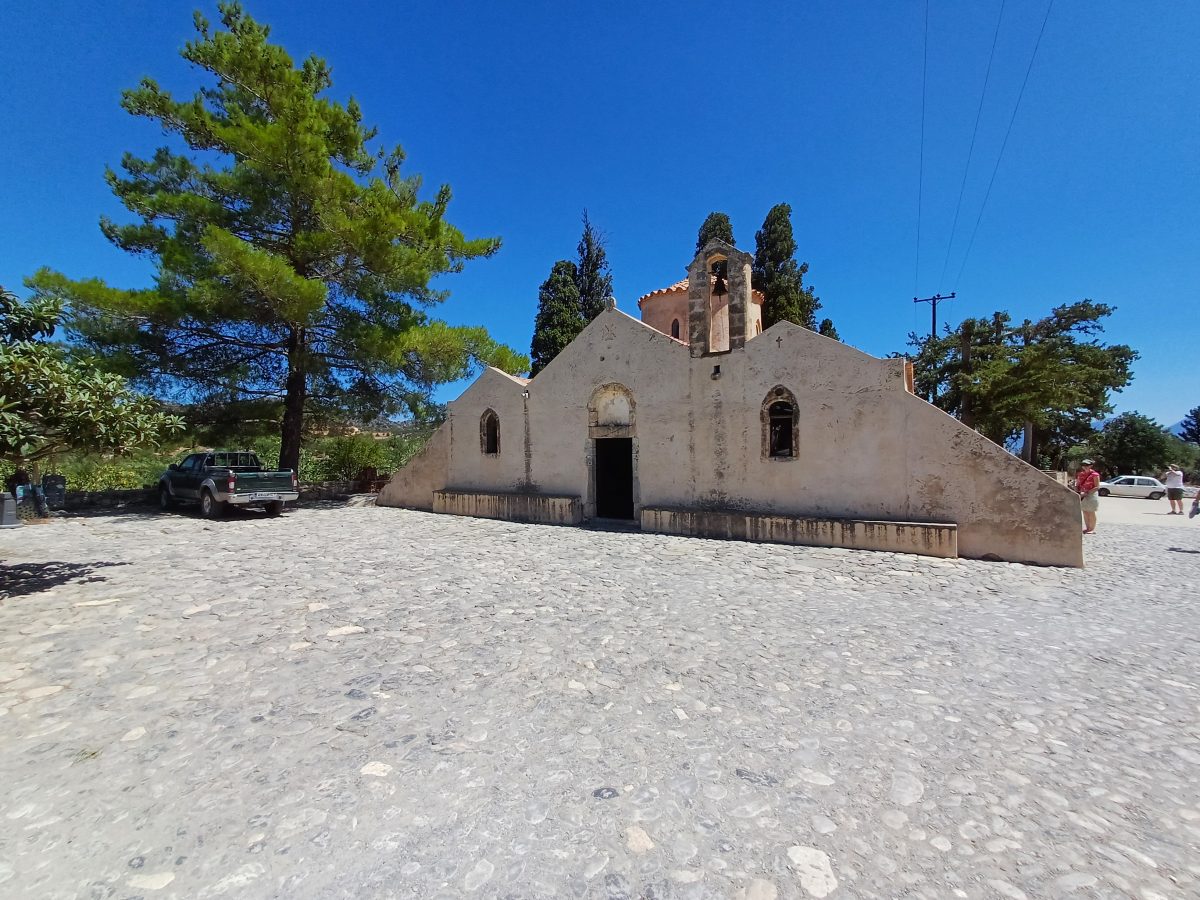
Almost every village celebrates an annual feast day honouring the saint to whom its church is dedicated.
These celebrations combine liturgical worship with music, food and hospitality, reflecting the deep integration of faith into everyday life.
For visitors, a village festival may appear to be a cultural event.
For local people, it is often an expression of centuries-old religious continuity.
A Living Tradition
Unlike many historical sites that exist only as monuments to the past, Crete’s churches and monasteries remain active places of worship.
The Divine Liturgy is still celebrated.
Monks continue their daily cycle of prayer.
Pilgrims continue to light candles, seek blessings and give thanks.
This living continuity distinguishes Crete’s sacred landscape from many other archaeological destinations in the Mediterranean.
Its history has never been frozen in time.
It continues to unfold.
Archaeological and Historical Perspective
Historical sources and archaeological evidence demonstrate that the Christianisation of Crete was not achieved through a single event but through centuries of gradual development. Missionaries, bishops, hermits and monastic communities shaped the island’s religious geography by establishing churches and monasteries in locations that combined spiritual significance with practical accessibility. These sacred places remain active today, making Crete not only a landscape of historical memory but also one of living faith.
Visiting Crete’s Sacred Places Today
“To understand Crete, it is not enough to admire its beaches. You must also listen to the silence of its monasteries, climb its sacred mountains and step inside its ancient chapels.”
For many visitors, Crete is synonymous with crystal-clear beaches, dramatic gorges and picturesque villages.
These attractions undoubtedly deserve their reputation.
Yet another Crete exists beyond the tourist brochures—a quieter island where faith, history and landscape remain inseparable.
Exploring Crete’s sacred places offers not simply a different excursion, but a different way of understanding the island itself.
More Than Religious Tourism
You do not need to be Orthodox—or even religious—to appreciate Crete’s sacred heritage.
Churches, monasteries and pilgrimage sites are also places of remarkable history, architecture, art and cultural memory.
Many visitors who enter a small mountain chapel expecting only a brief stop leave with a far deeper appreciation of Cretan life.
The silence itself often becomes part of the experience.
Respecting Living Places of Worship
Unlike archaeological ruins, most churches and monasteries in Crete remain active places of prayer.
Visitors should remember that they are entering spaces used daily by local communities.
Simple gestures of respect make a meaningful difference.
Dress modestly, particularly when visiting monasteries.
Speak quietly.
Avoid interrupting religious services.
Always ask permission before photographing monks or worshippers.
Such courtesies are appreciated everywhere but hold particular importance within Orthodox tradition.
Beyond the Famous Monasteries
Many travellers visit well-known monasteries such as Arkadi or Toplou.
These are undoubtedly among Crete’s most important religious landmarks.
Yet some of the island’s most memorable experiences take place in tiny chapels hidden among olive groves, perched on mountain ridges or overlooking the sea.
Often there is no entrance fee.
No ticket office.
No queue.
Only a candle, an icon and the sound of the wind.
These humble places frequently reveal more about the spiritual heart of Crete than its most famous monuments.
Following the Rhythm of the Local Calendar
Whenever possible, plan your visit around a village feast day (panigyri).
Throughout the year, communities celebrate their patron saints with Divine Liturgy, traditional music, local food and genuine hospitality.
For visitors, these festivals offer a rare opportunity to experience living tradition rather than a performance staged for tourism.
The celebrations vary from village to village, yet they all express the same values: faith, family and community.
A Different Kind of Journey
Travelling through Crete’s sacred landscape encourages a slower pace.
Instead of rushing from one attraction to another, visitors begin to notice small details:
A weathered icon beside a country road.
An ancient olive tree shading a chapel.
A spring where generations have paused to drink.
A mountain cross visible from miles away.
These seemingly ordinary moments reveal how deeply spirituality remains woven into everyday life.
The Soul of the Island
Crete has witnessed the rise and fall of Minoan civilisation, Greek city-states, Roman rule, Byzantine emperors, Venetian governors and Ottoman sultans.
Each left its mark.
Yet throughout these centuries, the island never lost its profound connection between faith and landscape.
That continuity is one of Crete’s greatest treasures.
For those willing to look beyond the obvious, every mountain, cave, spring, chapel and monastery becomes part of a much larger story—one that is still being written today.
Practical Suggestions for Travellers
If you wish to explore Crete’s sacred heritage:
- Visit both famous monasteries and lesser-known village chapels.
- Combine archaeological sites with nearby churches to appreciate the continuity of the landscape.
- Attend a local feast day if your visit coincides with one.
- Support local communities by visiting village cafés, bakeries and family-run tavernas.
- Allow time to pause rather than simply take photographs.
Sometimes the most memorable experience is not the one planned in advance.
Historical Perspective
Crete’s sacred places are not museums detached from modern life. They remain active expressions of the island’s cultural identity. Their significance lies not only in their architecture or antiquity, but also in the fact that they continue to serve the communities that built, preserved and worshipped in them across many generations. For travellers, visiting these places offers an opportunity to engage with one of Europe’s oldest continuously living spiritual landscapes.
Τέλεια. Τώρα γράφουμε το τελευταίο κεφάλαιο. Δεν θέλω να είναι απλώς ένα συμπέρασμα· θέλω ο αναγνώστης να κλείσει το άρθρο και να κοιτάξει την Κρήτη με διαφορετικά μάτια.
Conclusion: A Landscape Where Faith Never Stood Still
“Some places preserve monuments. Crete preserves a living conversation between people, nature and faith.”
After exploring Crete’s mountains, caves, springs, churches and monasteries, one conclusion becomes difficult to ignore.
The island’s sacred history is not a series of isolated chapters.
It is a continuous story.
For more than four thousand years, people have looked upon the same landscapes and recognised something greater than themselves.
The names changed.
The prayers changed.
The rituals changed.
But the human desire to seek meaning in these places remained remarkably constant.
Beyond the Myth of Replacement
It is often said that Christian churches were simply built over ancient pagan temples.
Reality is more complex.
Archaeology paints a richer picture.
Some ancient sanctuaries were indeed reused.
Many others were abandoned.
At the same time, countless churches were founded in entirely new locations, while some sacred mountains, caves and springs continued to attract religious devotion across different historical periods.
Rather than replacing one religion with another, Crete demonstrates how communities repeatedly interpreted the same landscape through new spiritual traditions.
This distinction is essential for understanding the island’s past.
A Living Sacred Landscape
One of the most remarkable characteristics of Crete is that its sacred geography has never become merely an archaeological curiosity.
Its monasteries still welcome pilgrims.
Its village churches still celebrate the Divine Liturgy.
Its feast days still gather entire communities.
Its mountain chapels still overlook valleys where shepherds continue to work the land.
Its holy springs still receive visitors seeking peace, hope or healing.
Few regions in Europe preserve such an uninterrupted relationship between landscape and living faith.
What Travellers Can Learn
For visitors, this continuity offers something far more valuable than another sightseeing stop.
It provides a deeper understanding of Crete itself.
The island’s identity cannot be explained solely through beaches, archaeological sites or picturesque villages.
Its character has also been shaped by centuries of prayer, pilgrimage, hospitality and community life.
To walk through Crete is to walk through layers of history that remain visible not only in stone, but in everyday life.
Looking Beyond the Guidebooks
Many travel guides introduce Crete through famous landmarks.
They recommend palaces, beaches and scenic drives.
All deserve to be visited.
Yet those who take time to enter a small chapel, climb to a mountain monastery or pause beside an ancient spring often discover a quieter side of the island.
It is here that the story of Crete becomes most personal.
Not because every visitor shares the same beliefs, but because everyone can recognise humanity’s timeless search for meaning.
The Enduring Spirit of Crete
Perhaps this is the greatest lesson of Crete’s sacred landscape.
Civilisations rise.
Empires fall.
Religions evolve.
Communities change.
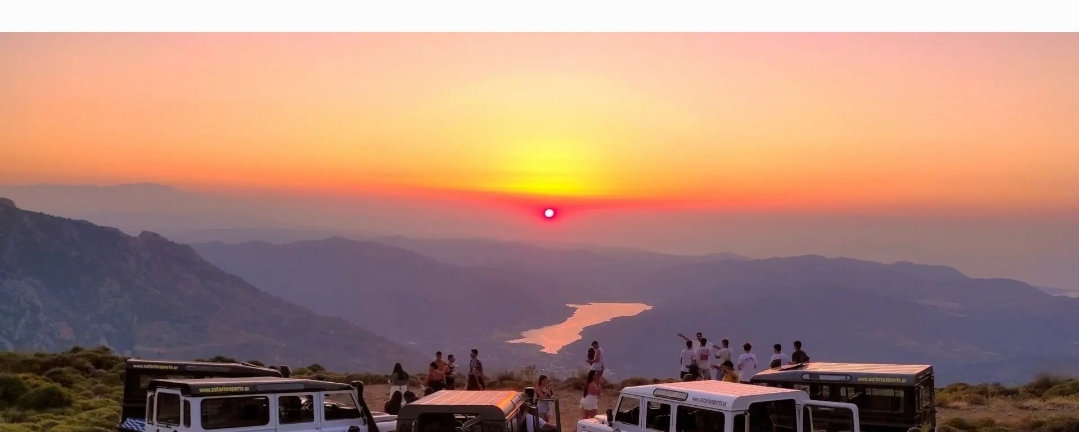
Yet generation after generation, people continue to return to the same mountains, the same caves, the same springs and the same places of prayer.
The landscape endures.
And with it, the hope that every generation may discover something greater than itself.
That is why Crete is far more than an island of extraordinary natural beauty.
It is one of Europe’s oldest living sacred landscapes—a place where history has never been separated from faith, and where the conversation between humanity, nature and the divine continues to this very day.
Author’s Note
As someone who was born and raised in Crete, I have always believed that the island is best understood not only through its famous archaeological sites or spectacular coastline, but also through its living traditions.
Writing this article has been an invitation to look beyond the obvious and to appreciate the remarkable continuity that links Crete’s prehistoric sanctuaries, Byzantine churches, mountain chapels and village communities.
Whether you visit as a historian, a pilgrim, or simply a curious traveller, I hope these places encourage you to experience a deeper and more authentic side of the island.
Safe travels — and may your journey through Crete be filled with discovery.
Stefanos Katrinakis
Founder, Stefanos Tours