
Saint Marina: The July 17 Feast Day and the Historic Pilgrimage in Voni, Crete
17/07/2026
Malia Old Town: A Peaceful Cretan Gem Just Minutes from Sissi
17/07/2026Every year on July 20, the Orthodox Church honours the Prophet Elijah, known throughout Greece as Profitis Ilias. He is one of the most important and recognisable figures of the Old Testament, remembered for his unwavering faith, his struggle against idolatry and his remarkable connection with fire, rain and the mountains. Prophet Elijah in Crete.
Visitors travelling through Crete may notice something unusual: many chapels dedicated to Prophet Elijah stand on hilltops, remote ridges and mountain peaks. Their whitewashed walls can often be seen from far away, rising above villages, fields and coastal settlements.
This is not a coincidence. The location of these chapels is connected with the prophet’s biblical life, the symbolism of mountains in Christianity and a rich collection of Greek folk traditions.
Who Was the Prophet Elijah?
The Prophet Elijah, or Elijah the Tishbite, lived during the 9th century BC and came from the mountainous region of Gilead, east of the River Jordan. His Hebrew name, Eliyahu, means “My God is the Lord”.
He lived during the reign of King Ahab and Queen Jezebel, at a time when the worship of Baal was spreading through the Kingdom of Israel. Elijah became a fearless defender of faith in the one true God, openly challenging both the royal authorities and the prophets of Baal.
One of the best-known moments of his life took place on Mount Carmel. There, according to the biblical account, Elijah challenged the prophets of Baal to call upon their god. When their efforts failed, Elijah prayed, and fire descended from heaven upon his offering.
Elijah is also closely associated with drought and rain. He warned that the land would suffer a long period without rain because the people had abandoned their faith. After several years of drought, he prayed once again, and the rain returned.
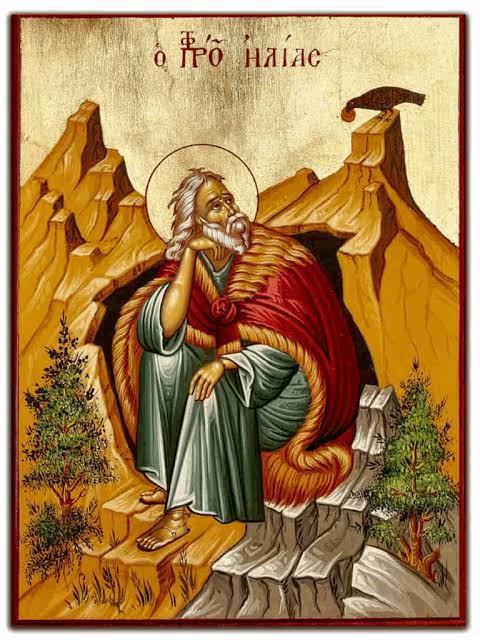
During his life, he sought refuge in the wilderness, was fed by ravens and received help from the poor widow of Zarephath. He later travelled to Mount Horeb, where he experienced the presence of God—not in the powerful wind, earthquake or fire, but in what Scripture describes as a gentle, quiet voice.
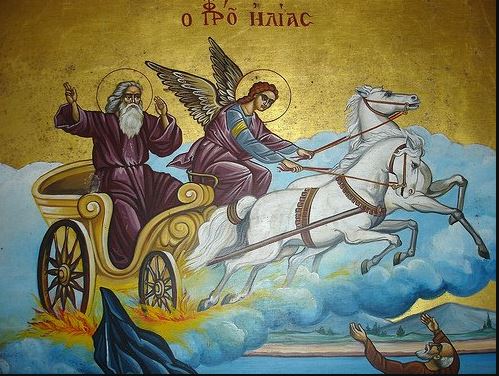
At the end of his earthly life, Elijah was not presented as dying in the usual way. According to the biblical narrative, he was taken up into heaven in a whirlwind, accompanied by a chariot and horses of fire, while his disciple Elisha watched.
The Prophet Elijah also appears in the New Testament. During the Transfiguration of Christ on Mount Tabor, he is seen beside Moses, representing the prophets, while Moses represents the Law.
The Orthodox Church commemorates the Prophet Elijah every year on July 20. The Apostoliki Diakonia of the Church of Greece describes him as a powerful defender of faith whose life was closely associated with mountains, fire, drought and divine revelation.
Why Are His Chapels Built on Mountain Peaks?
There is no single explanation for why so many chapels of Prophet Elijah stand on high ground. Instead, several different traditions come together.
The first explanation can be found in the Bible itself. Some of the most important events in Elijah’s life took place on mountains. His confrontation with the prophets of Baal happened on Mount Carmel, while his encounter with God took place on Mount Horeb.
His mysterious ascent into heaven in a chariot of fire also strengthened his symbolic association with the sky, the heavens and high places.
Mountains have always carried a powerful spiritual meaning within Christianity. They represent separation from the noise of everyday life, the difficult upward journey of the human soul and the search for an encounter with God. Reaching a remote chapel requires effort. The climb itself becomes part of the pilgrimage.
There is also a charming Greek folk legend that attempts to explain why Prophet Elijah abandoned the coast and chose the mountains.
According to the story, Elijah was once a sailor who had grown tired of the sea and its dangers. He placed an oar on his shoulder and began walking inland. Whenever he met someone, he asked what he was carrying. As long as people recognised it as an oar, he knew that he was still too close to the sea. He continued climbing until he reached a place where the local people had never seen an oar and mistook it for a piece of wood. There, far away from the sea, he decided to remain.
This is, of course, a folk tale rather than part of Church teaching. Nevertheless, it reveals how deeply Prophet Elijah became connected with the mountains in the Greek imagination.
Some historians and folklorists also suggest that chapels dedicated to Prophet Elijah were sometimes constructed near older mountaintop sacred sites. In this interpretation, Christian worship gradually gave new meaning to places that had been considered sacred since antiquity. This cultural explanation should not be confused with the biblical and theological reasons, but it forms part of the fascinating history of Greek religious tradition.
The Special Place of Prophet Elijah in Crete
Prophet Elijah holds a particularly important place in the religious life of Crete. This is hardly surprising on an island shaped by mountains, isolated villages, farming communities and a centuries-old dependence on the weather.
For generations, Cretan families depended upon the winter rain for their olive trees, vineyards, grain and livestock. Drought could destroy an entire year’s work. Because the biblical life of Elijah is so closely connected with rain, drought, clouds and fire, his story had a very direct meaning for the people of the countryside.
His feast is celebrated in the heart of the Cretan summer, when the landscape is dry and the heat is often at its most intense. On the evening of July 19 and the morning of July 20, people climb towards remote chapels to attend Vespers, Matins and the Divine Liturgy.
In many villages, the religious service is followed by a traditional gathering with food, Cretan music and dancing. Yet the heart of the celebration remains the difficult journey towards the chapel, the lighting of a candle and the quiet prayer made at the top of the mountain.
Chapels and churches dedicated to Prophet Elijah can be found across Crete—from the historic Venetian-era monastery near Roustika in Rethymno to the heights of Stroumboulas, the hill of Kopsas in Anopolis and the famous site above Chania where the graves of Eleftherios and Sofoklis Venizelos are located.
Each place has its own history, but they share the same image: a small church standing between the earth and the sky.
The Chapel of Prophet Elijah Above Malia
A particularly picturesque chapel dedicated to Prophet Elijah dominates a small hill above Malia, in eastern Crete. Although the hill rises to only about 105 metres, its open position offers beautiful panoramic views across the surrounding countryside, the coastline of Malia and the Cretan Sea.
The chapel is simple and peaceful, standing away from the noise and activity for which modern Malia is often known. From the hill, visitors can see another side of the area: cultivated fields, the old village, the archaeological landscape and the long northern coastline of Crete.
A rewarding walking route begins among the narrow streets of Old Malia and continues towards the Chapel of Prophet Elijah. From there, walkers can descend towards the Minoan Palace of Malia and Potamos Beach. The route combines traditional village architecture, religious heritage, archaeology and nature in a single journey. It is also recognised as a local walking route by Greek Travel Pages, while the Heraklion Mountaineering Club identifies the chapel’s hill at approximately 105 metres.
The chapel may not have the monumental architecture of a large monastery, but this is precisely where its beauty lies. Its quiet location and panoramic view allow visitors to understand why the people of Crete selected high and peaceful places in which to build their small places of worship.
Around July 20, the chapel acquires an even deeper meaning, connecting the landscape above Malia with a religious tradition observed on mountain peaks throughout Greece.
Visitors wishing to walk to the chapel should avoid the hottest hours of the summer day, carry water and wear suitable shoes. As with every Orthodox place of worship, the site should be approached with respect, modest clothing and consideration for local worshippers.
Discovering the Real Crete
The chapels of Prophet Elijah remind us that Crete cannot be understood only through its beaches, hotels and archaeological sites. Its true identity also lives in the small churches above its villages, the mountain paths followed by generations of pilgrims and the traditions that continue to bring communities together.
At Stefanos Tours, what matters to us is not simply whether you book your excursions with us. What truly matters is helping you discover the real Crete—its people, history, faith and traditions.
On July 20, when the bells ring from remote hills and mountain peaks, Crete honours one of the greatest prophets of the biblical world:
Holy Prophet Elijah, intercede for us.