

Alisiva: Where Cretan Tradition Meets Monastic Cuisine in Sissi, Crete
21/07/2026
Rent a Boat in Sissi Crete: Everything You Should Know Before Taking the Helm
25/07/2026Discover the Ancient Hill That Shaped the Story of Sissi
“Some places become famous because history was written there. Others become unforgettable because history still lies beneath your feet.”
Dedicated with gratitude
This article is respectfully dedicated to Professor Jan Driessen, the SARPEDON Project, and to every archaeologist, conservator, architect, surveyor, scientist, student and volunteer whose dedication over nearly two decades has revealed the extraordinary story of ancient Kefali Sissi.
Their work has not simply uncovered an archaeological site.
It has restored an important chapter of Crete’s history and returned it to the people of Sissi and to visitors from around the world.
Introduction
Ask almost anyone who has visited Sissi to name their favourite place, and there is a good chance they will mention Boufos.
Some remember swimming in its remarkably clear waters.
Others remember watching the sunset as golden light spread across the rocks and the sea became perfectly still.
Children remember jumping from the rocks into the sea.
Photographers remember one of the most beautiful coastal landscapes in northern Crete.
For most visitors, Boufos is simply a beautiful place.
For local people, it is much more than that.
Growing up in a family whose roots in Sissi stretch back for generations, Boufos was never just another beach. It was part of everyday life. It was where families gathered on warm summer evenings, where fishermen watched the changing weather, where children learned to swim and where countless sunsets quietly marked the passing of another day.
For many years, I admired this landscape without fully appreciating the extraordinary history hidden beneath it.
Only later did I realise that the peaceful hill overlooking Boufos has been watching over this coastline for more than four thousand years.
That hill is known as Kefali Agiou Antoniou, or simply Kefali, and locally as Kremasma.
Perched between the small coves of Boufos and Avlaki, it occupies one of the most strategic locations on Crete’s northern coast. From here, the land opens towards the Selinari Gorge, the natural corridor that has linked central and eastern Crete since prehistoric times, while the surrounding coastline provides sheltered access to the sea.
It is a place where land and sea meet in remarkable harmony.
It is hardly surprising that the first settlers recognised its potential.
Long before the first hotels welcomed visitors…
Long before fishing boats moored in the harbour…
Long before the Chapel of Saint Anthony overlooked the bay…
People had already chosen this hill as their home.
For almost fourteen centuries, generations of Minoans lived here.
They built houses.
Raised families.
Worked the land.
Fished these same waters.
Welcomed traders arriving by sea.
Celebrated religious ceremonies.
Buried their loved ones.
Survived earthquakes.
Rebuilt their community.
And continued looking towards the same blue horizon that visitors admire today.
Eventually, their voices disappeared.
Their homes collapsed.
Their streets were covered by centuries of earth.
Nature slowly reclaimed the hill.
For thousands of years, Kefali kept its story to itself.
The archaeological importance of the site first came to light in the 1960s through the pioneering work of the Greek archaeologist Kostas Davaras, who recognised that the quiet hill above Boufos concealed the remains of an important Bronze Age settlement.
Several decades later, systematic excavations carried out by the Belgian School at Athens through the SARPEDON Project, under the direction of Professor Jan Driessen, revealed the true significance of the site.
Year after year, careful scientific research uncovered not only impressive buildings and remarkable artefacts, but something far more valuable.
It revealed the lives of ordinary people.
Today, the archaeological research at Kefali is widely regarded as one of the most significant long-term investigations of a Minoan settlement in eastern Crete, offering valuable new insights into communities that flourished beyond the great palatial centres.
Yet despite its scientific importance, many visitors enjoying Boufos have little idea that one of Crete’s most fascinating archaeological landscapes lies only a short walk above them.
That is why this story deserves to be told.
Not only for archaeologists.
Not only for historians.
But for everyone who loves Sissi.
Because once you understand what happened here, you never look at Boufos in quite the same way again.
Where Sea, Land and History Meet
Walk slowly towards the hill of Kefali.
Before thinking about archaeology, simply stop for a moment.
Listen.
The gentle sound of the waves reaching the rocks below.
The wind carrying the scent of wild thyme from the surrounding hillsides.
The distant song of cicadas on a warm summer afternoon.
The endless blue of the Aegean stretching beyond the horizon.
Now turn slowly.
To the west lies the Bay of Malia.
To the east, the rugged coastline stretches towards Milatos.
Behind you rises the landscape of inland Crete, where the Selinari Gorge has connected eastern and central Crete since prehistoric times.
It is an extraordinary viewpoint.
Even without knowing its history, you instinctively feel that this is an important place.
The first settlers felt exactly the same.
More than four thousand years ago, they were not searching for beautiful scenery.
They were searching for survival.
Kefali offered almost everything a growing Bronze Age community could hope for.
The hill provided natural protection and uninterrupted views across both land and sea.
Sheltered coves below offered safe landing places for small boats travelling along Crete’s northern coastline.
Fresh water was available nearby.
Fertile land surrounded the settlement.
Fishing grounds lay only a short walk from home.
Building stone could be gathered from the landscape itself.
Trade routes passed within easy reach.
Few places combined so many natural advantages in such a compact area.
The decision to settle here was not an accident.
It was the result of careful observation, practical knowledge and generations of experience living in harmony with the landscape.
Looking across the sea today, it is remarkably easy to understand why the first settlers chose this hill.
The view has changed very little.
The sea remains the same.
The mountains still frame the horizon.
The wind still carries the scent of Crete across the landscape.
Only the people are different.
Or perhaps not as different as we sometimes imagine.
Thousands of years separate us from the first inhabitants of Kefali.
Yet if we had stood beside them on this very hill at sunset, both of us would almost certainly have paused to admire exactly the same view.
Perhaps that simple thought is the best place to begin understanding ancient Sissi.
Because archaeology is not only about discovering the past.
It is about recognising ourselves within it.
The First People of Kefali
Imagine approaching the northern coast of Crete more than four thousand years ago.
There are no roads.
No hotels.
No harbour.
No village.
Only a rugged coastline shaped by wind, waves and time.
As a small wooden boat glides towards the shore, one rocky hill immediately attracts attention.
It rises gently above a series of sheltered coves, commanding magnificent views across the Bay of Malia and the open sea beyond.
To experienced seafarers, it is more than an attractive landmark.
It is a place that offers security.
Fresh water lies within reach.
Fertile land stretches inland.
Natural anchorages provide shelter from changing winds.
The surrounding landscape offers stone for building, fertile soil for cultivation and easy access to one of Crete’s most important natural routes through the Selinari corridor.
For a growing community, it is close to ideal.
Long before archaeologists understood its significance, the first settlers had already recognised its potential.
Their decision would shape the history of Sissi for almost fourteen centuries.
The Birth of a Community
Archaeological evidence indicates that the first permanent settlement at Kefali was established during the Early Minoan period, around 2600 BC.
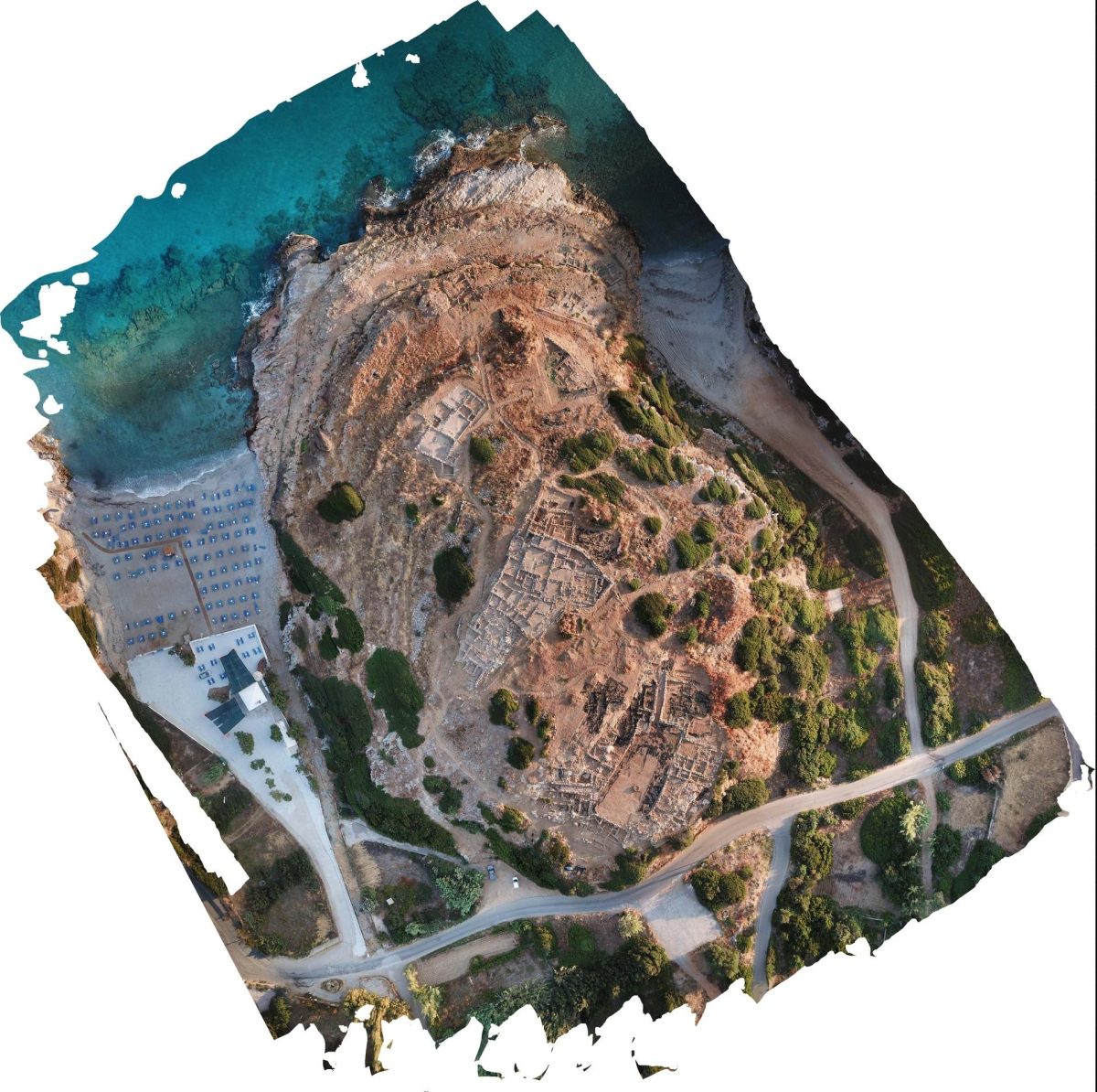
At first, it was almost certainly a modest community.
A small number of families built simple homes using locally available stone, timber and clay.
Life revolved around the rhythm of nature.
The sea provided fish.
The surrounding land produced cereals, olives and grapes.
Goats and sheep grazed on nearby hillsides.
Every season brought different challenges and different opportunities.
There were no monuments.
No palaces.
No kings whose names would survive in history.
There were simply people building a future for their families.
And perhaps that is precisely why Kefali is so important today.
Its story begins not with rulers, but with ordinary lives.
A Settlement That Grew with Confidence
Over the centuries, the small settlement gradually expanded.
New houses appeared.
Older buildings were repaired, enlarged or replaced.
Open spaces became places where neighbours gathered.
Workshops supported local crafts.
Storage areas reflected growing prosperity.
The community became increasingly organised, adapting to changing circumstances while remaining closely connected to the surrounding landscape.
This gradual development is one of the reasons why Kefali is so valuable to archaeology.
Rather than preserving a single moment frozen in time, it records the steady evolution of a living community across many generations.
Each archaeological layer tells another chapter of that story.
Each building reflects another generation adapting to new realities while remaining rooted in the same place.
Living Beside a Great Palace
Only a short distance to the west, another settlement was following a very different path.
Malia would eventually become one of the great palatial centres of Minoan Crete.
It is tempting to imagine that every nearby community simply depended upon the palace.
Reality was almost certainly far more complex.
Like many settlements across Bronze Age Crete, Kefali maintained close connections with larger centres through trade, religious traditions, craftsmanship and the movement of people.
At the same time, it developed its own local identity.
It was not simply an extension of Malia.
It was a community with its own history, its own landscape and its own role within a wider network of Minoan settlements.
This distinction matters.
For many years, archaeological research naturally focused on the great palaces.
Today, sites such as Kefali remind us that no civilisation can be understood by studying only its centres of power.
To understand the Minoan world, we must also understand the communities that cultivated the land, supplied goods, maintained maritime connections and shaped everyday life beyond the palace walls.
Kefali is one of those communities.
And thanks to the work carried out here over the past two decades, it has become one of the clearest windows through which we can explore that world.
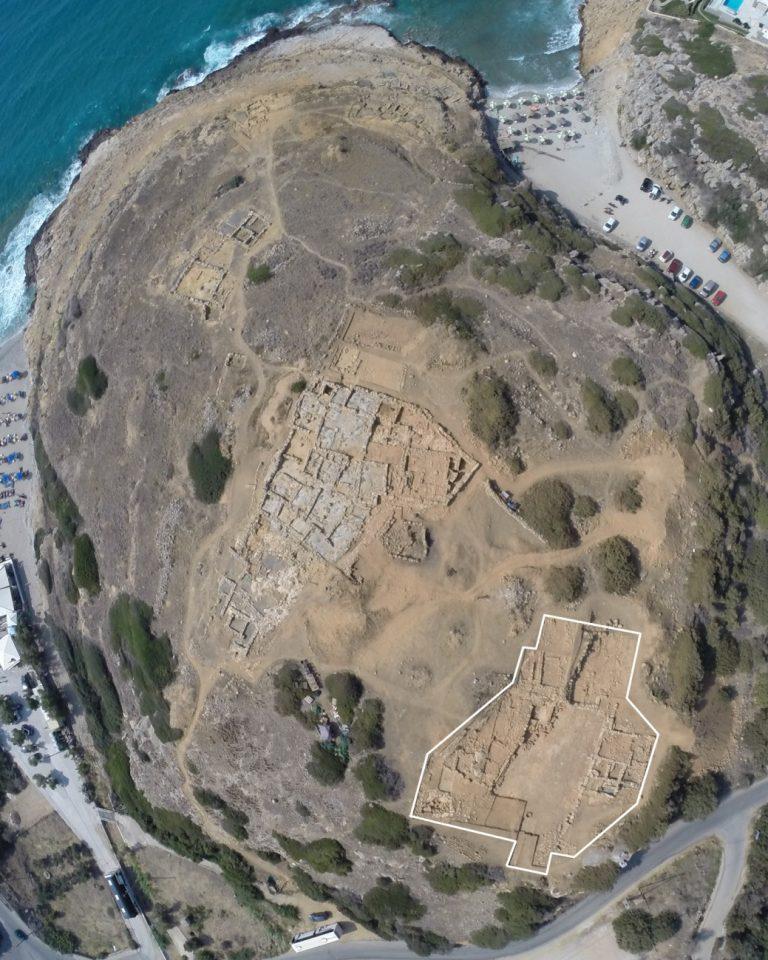
More Than Stones
Visitors sometimes ask a simple question.
“Why are archaeologists so interested in a place where only the foundations of buildings remain?”
The answer is equally simple.
Because archaeologists do not excavate stones.
They excavate evidence.
A doorway tells us how people moved through their homes.
A hearth reveals where families prepared meals.
Fragments of pottery preserve clues about trade, technology and daily life.
Seeds recovered from the soil speak of agriculture.
Animal bones reveal diet and husbandry.
Even microscopic traces invisible to the human eye can transform our understanding of an ancient settlement.
At Kefali, every discovery becomes part of a much larger conversation.
One wall alone means very little.
Thousands of carefully recorded observations, brought together through years of scientific study, begin to reveal something extraordinary.
Not simply what ancient Sissi looked like.
But how it functioned.
How it changed.
How it adapted.
And how generations of people transformed a rocky hill above the sea into a thriving Minoan community.
A Quiet Beginning to an Extraordinary Story
If you visit Kefali today, it is easy to be captivated by the view.
Yet the true significance of this hill does not lie only in its landscape.
It lies in the lives that unfolded here over hundreds of years.
Children were born here.
Skills were passed from one generation to the next.
Friendships were formed.
Families mourned their dead.
Neighbours helped rebuild after hardship.
The foundations that visitors see today are the remains of those lives.
They remind us that every great civilisation begins in places that often seem ordinary.
A small hill.
A sheltered bay.
A handful of families.
And a decision to stay.
It was here, on this quiet headland overlooking Boufos, that the long story of ancient Sissi truly began.
A Day in Ancient Kefali
Imagine arriving at Kefali not as a visitor from the twenty-first century, but as someone approaching this hill almost four thousand years ago.
The sea is calm.
The first light of dawn has only just touched the northern coast of Crete, turning the water shades of silver and pale blue.
From your small wooden boat, the settlement slowly comes into view.
Simple stone buildings rise above the shoreline.
Thin columns of smoke drift into the still morning air.
The day has already begun.
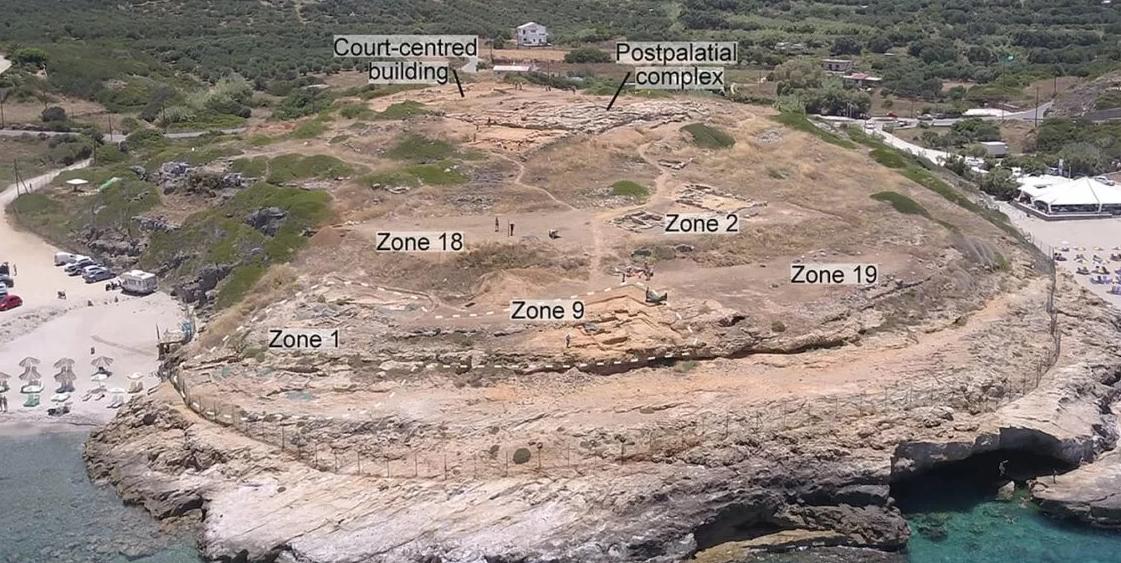
As the Village Awakens
Before sunrise, the settlement is quiet.
Then, little by little, it comes to life.
A doorway opens.
Another follows.
The sound of footsteps echoes through narrow lanes between the houses.
Somewhere, grain is already being ground into flour.
Nearby, a fire is being lit for the morning meal.
The smell of bread baking on a clay hearth mixes with the salty air carried inland from the sea.
Children begin to appear in the open spaces between the houses.
Their laughter drifts through the settlement as naturally as the morning breeze.
For them, Kefali is not history.
It is simply home.
Living with the Sea
The sea is never far away.
It provides food.
It offers communication with neighbouring communities.
It brings opportunities—but also uncertainty.
Below the settlement, small boats are prepared for another day’s work.
Some fishermen inspect woven nets before pushing their vessels into the water.
Others check ropes, wooden paddles and simple tools that have been repaired many times before.
No one knows exactly what today’s catch will bring.
Life beside the sea has always required patience.
The same remains true in Sissi today.
Standing above Boufos on a quiet morning, it is impossible not to feel that connection.
The boats may have changed.
The coastline has altered slightly through the centuries.
Yet the rhythm of the sea remains remarkably familiar.
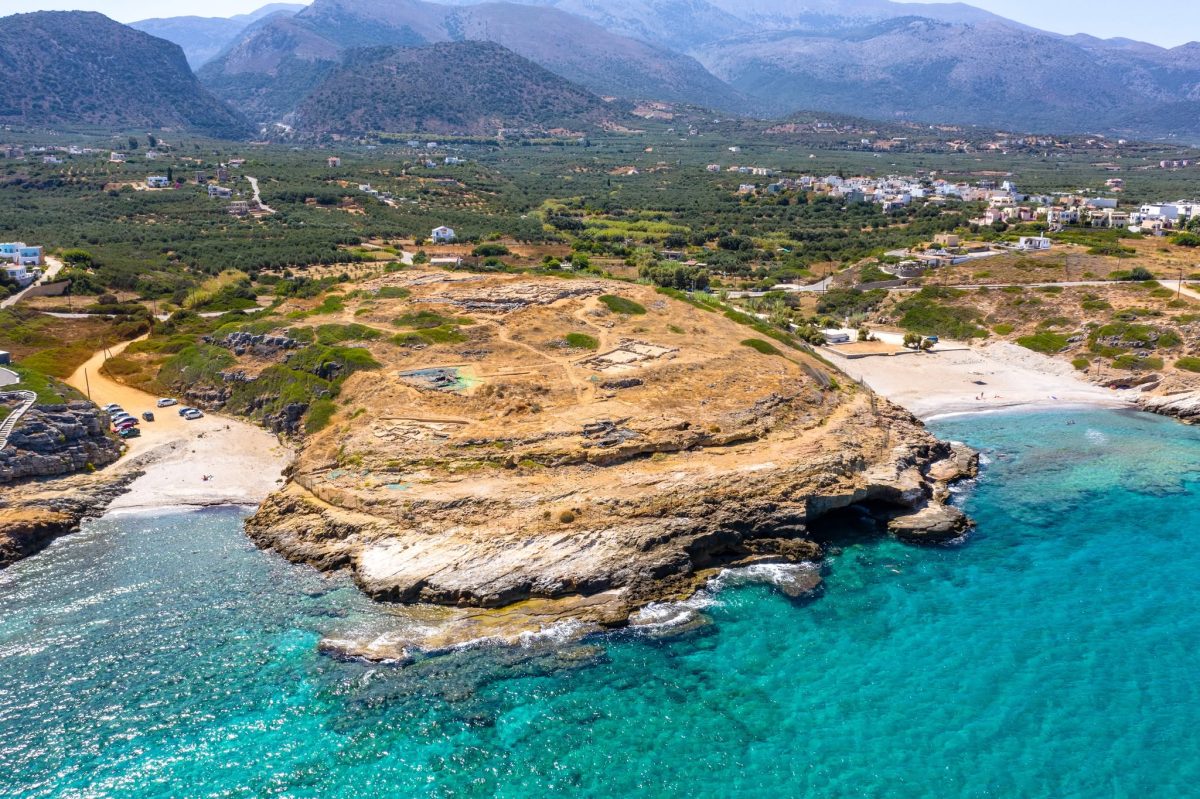
Fields Beyond the Hill
Not everyone begins the day on the water.
As sunlight spreads across the landscape, others leave the settlement carrying baskets and simple tools.
Beyond the rocky slopes of Kefali lie fertile areas capable of supporting crops and livestock.
Archaeological and environmental evidence from Minoan Crete shows that communities like this depended upon a carefully balanced economy.
Cereals provided essential food.
Olive trees offered oil for cooking, lighting and trade.
Vines produced grapes that could be eaten fresh, dried or transformed into wine.
Goats and sheep supplied milk, wool and meat.
Wild plants collected from the surrounding countryside added both flavour and medicine to daily life.
Nothing was wasted.
Everything had value.
The Sound of Craftsmanship
As the day progresses, another rhythm begins to fill the settlement.
The steady scraping of stone.
The careful shaping of clay.
The tapping of tools against wood.
The controlled heat of a furnace.
Although only fragments survive today, archaeology reveals a community whose people possessed considerable skill and practical knowledge.
Pottery was produced not merely for beauty, but for life itself.
Storage jars protected precious food supplies.
Cooking vessels served family meals.
Smaller containers carried oils, perfumes and other valuable goods.
Craftsmanship was woven into everyday existence.
Every object had a purpose.
Every object reflected experience passed from one generation to the next.
A Community Connected to the Wider World
Despite its peaceful setting, Kefali was never isolated.
Crete during the Bronze Age was a world connected by the sea.
Boats travelled between coastal communities, carrying not only goods but also ideas, traditions and technology.
New styles of pottery appeared.
Architectural influences spread.
Religious practices evolved.
Materials arrived from distant places.
Others left the settlement in return.
The people of Kefali lived within this wider network while maintaining their own local identity.
This balance between openness and individuality is one of the reasons why the site continues to fascinate researchers today.
It reminds us that even relatively small communities played an active role in the remarkable civilisation we now call Minoan.
Moments That Leave No Trace
Not every part of life leaves an archaeological footprint.
Some of the most meaningful moments disappear completely.
A conversation between neighbours.
A mother comforting her child.
Friends sharing a meal after a successful day at sea.
Someone sitting quietly on the hill, watching the evening sun disappear beyond the Bay of Malia.
Archaeology cannot recover those moments.
But it reminds us that they existed.
Behind every excavated wall stood a family.
Behind every hearth was a shared meal.
Behind every doorway was a human story.
Perhaps this is the greatest lesson Kefali offers us.
The people who lived here were not so different from ourselves.
They hoped.
They worked.
They worried.
They celebrated.
They loved the place they called home.
Looking Towards Tomorrow
As daylight slowly fades, the settlement grows quieter once again.
Fishing boats return to the shore.
Animals are brought back towards their shelters.
Evening meals are prepared.
Voices fill the open spaces between the houses.
Children, exhausted from another day of play, gradually disappear indoors.
Above them all, the hill grows silent.
No one living there could possibly imagine that thousands of years later, people from every corner of the world would stand among the remains of their homes, trying to understand who they were.
They were not building history.
They were simply living their lives.
And perhaps that is why their story continues to move us today.
Because the greatest legacy of Kefali is not found in gold or stone.
It is found in the quiet dignity of ordinary lives, preserved through the patient work of archaeology and shared, once again, with the world.
Why Did This Small Hill Change What We Know About the Minoans?
It is a fair question.
Standing on Kefali today, surrounded by low stone walls and quiet archaeological remains, many visitors wonder why this seemingly modest hill has attracted the attention of researchers from across the world.
After all, Crete is home to famous archaeological sites.
Knossos.
Phaistos.
Malia.
Zakros.
Compared with these great palatial centres, Kefali appears almost understated.
And yet, appearances can be wonderfully misleading.
Its importance does not lie in monumental architecture.
Nor does it depend on spectacular treasures.
Instead, Kefali offers something that archaeology values just as highly.
Perspective.
Looking Beyond the Palaces
For more than a century, the great palaces naturally dominated the study of Minoan civilisation.
Their impressive buildings, colourful frescoes, monumental courtyards and sophisticated architecture transformed our understanding of Bronze Age Crete.
They deserved every bit of attention they received.
But every civilisation is much larger than its capitals.
Behind every palace stood farmers cultivating the land.
Fishermen supplying coastal communities.
Craftsmen producing pottery, tools and textiles.
Merchants transporting goods by sea.
Families raising children and preserving traditions across generations.
Without communities like Kefali, the great palaces could never have flourished.
Understanding those communities allows archaeologists to understand the civilisation itself.
That is why sites like Sissi have become so important.
They help complete a picture that once relied almost entirely on the largest centres of power.
A Community That Refused to Stand Still
One of the most remarkable aspects of Kefali is its continuity.
The settlement was not built in a single moment before disappearing forever.
Instead, it evolved.
Generation after generation, people adapted the community to changing circumstances.
Buildings were extended.
Older structures were rebuilt.
Open spaces acquired new functions.
Religious practices developed.
Architecture responded to earthquakes, social change and new ideas arriving from elsewhere in Crete.
Archaeologists often describe sites like this as preserving a sequence.
For the rest of us, there is perhaps a simpler way to understand it.
Imagine opening a family photo album.
The first photograph shows grandparents as young adults.
The next shows them with children.
Then grandchildren appear.
Faces change.
Clothes change.
The world changes.
Yet it is still the same family.
Kefali is rather like that album.
Each archaeological layer preserves another generation living on the same hill, facing new challenges while remaining connected to those who came before.
The Great Court
Among the discoveries that have attracted particular attention is the large open space now known as the Great Court, covering approximately 450 square metres.
Unlike the enclosed rooms surrounding it, this was a place designed to bring people together.
Although archaeology cannot recreate every event that took place there, spaces of this kind were clearly central to community life.
Ceremonies.
Gatherings.
Shared activities.
Moments when individuals became part of something larger than themselves.
Standing there today, it is impossible not to imagine hundreds of footsteps crossing the same ground over many generations.
Children watching from nearby buildings.
Neighbours greeting one another.
Communal life unfolding beneath the open Cretan sky.
The Great Court reminds us that ancient communities were not defined only by private homes.
They also created places where society itself could come together.
A Sacred Landscape
Religion was woven into everyday life throughout Minoan Crete.
Kefali was no exception.
Among the discoveries made during the excavations are ritual objects, including the distinctive snake tube, an artefact closely associated with Minoan religious practice.
These discoveries suggest that spiritual life formed an integral part of the settlement rather than existing separately from it.
Daily activities and religious expression belonged to the same landscape.
This relationship becomes particularly thought-provoking when standing on the hill today.
Only a short distance from the excavated remains stands the small Chapel of Saint Anthony.
No archaeological evidence suggests a direct continuity between the ancient sanctuary and the Christian chapel.
To claim such a connection would go beyond the available evidence.
Yet across Crete—and indeed across much of the Mediterranean—there are many examples of places that have remained spiritually significant across different historical periods.
Prominent hills.
Springs.
Caves.
Mountain peaks.
Generation after generation, people have returned to landscapes that somehow invite reflection, prayer and contemplation.
Whether by memory, tradition or the enduring character of the place itself, some landscapes seem to retain a quiet sense of the sacred.
Kefali is surely one of them.
The Cemetery That Still Speaks
No civilisation can be understood only through the places where people lived.
We must also understand how they honoured those who died.
The cemetery at Kefali has provided researchers with invaluable evidence about burial customs, social organisation and changing traditions over time.
Every burial represents an individual life.
Someone who once walked these same paths.
Shared meals with family.
Worked the land.
Looked across the sea.
Their names have disappeared.
Yet archaeology has preserved fragments of their stories.
Perhaps that is one of the most moving aspects of the excavations.
They remind us that history is never simply about buildings.
It is always about people.
Forty-Six Pieces of Gold… and Something Even More Valuable
The discovery of 46 gold objects naturally captures attention.
Gold has always fascinated people.
It still does.
Yet if you ask an archaeologist what the greatest treasure of Kefali is, the answer might surprise you.
Knowledge.
A gold ornament removed from its original setting is simply an attractive object.
A gold ornament carefully documented exactly where it was found becomes evidence.
It can reveal chronology.
Trade.
Craftsmanship.
Status.
Connections with other communities.
In archaeology, context is often more valuable than the object itself.
This is why every discovery at Kefali—whether a gold ornament, a fragment of pottery or a simple stone wall—has been recorded with extraordinary precision.
Each one contributes another sentence to a story that researchers are still learning to read.
More Than an Excavation
Perhaps this is the greatest achievement of the work carried out at Kefali.
It has shown that a relatively small coastal settlement can transform the questions we ask about an entire civilisation.
Not because it replaces Knossos.
Not because it competes with Malia.
But because it complements them.
Civilisations are not built by palaces alone.
They are built by communities.
By families.
By craftsmen.
By sailors.
By farmers.
By children growing up beneath the same sky.
Kefali allows us to meet those people again.
And in doing so, it reminds us that the story of the Minoans was never written only in great monuments.
It was also written in places like this.
On a quiet hill above the sea.
Earthquakes, Change and the Resilience of a Community
There is one force that has shaped Crete throughout its history more than any king, army or civilisation.
The earth itself.
Crete lies along one of the most active seismic zones in the Mediterranean. Earthquakes have always been part of life on the island, reminding every generation that even the strongest buildings are never permanent.
The people of ancient Kefali understood this reality all too well.
Their settlement did not simply grow through peaceful centuries of uninterrupted prosperity.
It endured periods of destruction.
It adapted.
It rebuilt.
Again and again.
This is one of the most remarkable stories hidden beneath the stones of Kefali.
Not the story of a civilisation that never faced hardship.
But the story of a community that repeatedly chose to begin again.
Reading Time Beneath the Ground
To most visitors, the archaeological remains appear as a collection of walls and foundations.
To an archaeologist, they resemble the pages of a history book.
Every layer of soil.
Every rebuilt wall.
Every repaired floor.
Every collapsed building.
Each preserves evidence of another chapter in the life of the settlement.
Unlike written history, archaeology does not begin with names or dates.
It begins with careful observation.
A change in the colour of the soil.
A different style of masonry.
Fragments of pottery sealed beneath a floor.
Charcoal preserved by chance.
These seemingly insignificant details allow researchers to reconstruct events that took place thousands of years ago.
Slowly, patiently and often over many years, a sequence begins to emerge.
Not a single dramatic moment.
But the rhythm of centuries.
When the Ground Moved
We cannot know what the inhabitants of Kefali felt during an earthquake.
No written account survives.
No witness recorded the event.
Yet archaeology allows us to recognise its consequences.
Collapsed walls.
Buildings repaired or replaced.
Changes in architectural design.
New construction rising upon earlier remains.
These are the silent signatures left by natural disasters.
For the people living here, an earthquake was not merely a geological event.
It threatened homes.
Food stores.
Workshops.
Places of gathering.
Perhaps even lives.
The landscape they trusted could suddenly become uncertain.
And yet, they stayed.
Again and again, the archaeological evidence shows a determination not to abandon the hill, but to rebuild it.
Choosing to Remain
This decision may seem obvious today.
But in the Bronze Age, rebuilding an entire community demanded enormous effort.
Stone had to be collected.
Timber gathered.
Walls reconstructed.
Storage rebuilt.
Daily routines re-established.
None of this happened overnight.
Every rebuilt house represents countless hours of labour.
Every repaired street reflects cooperation between neighbours.
Every new generation inherited not only buildings, but also the responsibility to preserve the community for those who would follow.
This quiet determination is perhaps one of the most inspiring aspects of Kefali.
Its history is not defined only by what was destroyed.
It is defined by what people chose to rebuild.
Architecture That Tells a Story
One of the reasons archaeologists value Kefali so highly is that its architecture records these changing phases with remarkable clarity.
The settlement was never static.
Buildings evolved.
Rooms acquired new purposes.
Walls were strengthened.
Entrances altered.
Older structures became the foundations for newer ones.
Rather than erasing the past, each generation quite literally built upon it.
Walking through the excavated remains today, visitors are often looking at several centuries of architectural history compressed into a single view.
What appears to be one wall may actually represent different moments in time.
What appears to be a single building may preserve evidence of several generations adapting the same space to changing needs.
This layered complexity is one of archaeology’s greatest challenges—and one of its greatest rewards.
A Lesson Beyond Archaeology
There is something quietly moving about a settlement that refused to disappear.
History often celebrates dramatic victories and famous rulers.
Kefali tells a different story.
It reminds us that resilience is rarely spectacular.
More often, it is found in ordinary decisions.
Repairing a damaged house.
Planting another harvest.
Launching another fishing boat.
Lighting another evening fire.
Continuing everyday life despite uncertainty.
Perhaps that is why this hill still speaks to us today.
Its greatest achievement was not avoiding hardship.
It was enduring it.
The Landscape That Remembered
Eventually, the people of Kefali left.
The reasons were complex, shaped by wider social and political changes across Crete rather than by a single event.
Their homes gradually fell into ruin.
Roofs collapsed.
Walls weathered.
Earth slowly covered the remains.
Wild plants reclaimed the hill.
For centuries, silence returned.
Yet the landscape never truly forgot.
Beneath every layer of soil, traces of those lives remained patiently preserved.
Waiting.
Not for treasure hunters.
Not for legends.
But for careful scientific inquiry.
When archaeologists finally began uncovering the settlement, they were not discovering a lost civilisation.
They were rediscovering a conversation that had simply been interrupted for thousands of years.
Resilience Across Four Thousand Years
Standing on Kefali today, it is difficult not to reflect upon the extraordinary continuity of this place.
Generations have come and gone.
Empires have risen and fallen.
Religions have changed.
Languages have evolved.
The village of Sissi has grown around the landscape in ways the ancient inhabitants could never have imagined.
Yet the hill remains.
The sea still reaches the shore below.
The wind still crosses the same ridge.
The evening sun still disappears beyond the Bay of Malia.
Nature continues the rhythm that first attracted settlers more than four millennia ago.
Perhaps that is the deepest lesson of Kefali.
Civilisations may not last forever.
Communities change.
Buildings disappear.
But the relationship between people and place has a remarkable ability to endure.
And nowhere is that relationship more beautifully preserved than on this quiet hill above Boufos.
From Objects to Stories: The Discoveries That Brought Ancient Sissi Back to Life
When people hear the word archaeology, they often imagine dramatic discoveries.
A golden treasure.
A perfectly preserved statue.
An ancient inscription waiting to reveal forgotten secrets.
Reality is usually much quieter.
Most archaeological discoveries are fragments.
A broken pot.
A collapsed wall.
A worn stone step.
A handful of seeds.
Animal bones.
Tiny pieces of charcoal.
On their own, they may seem ordinary.
Together, they become extraordinary.
This is exactly what has happened at Kefali.
The excavations have not uncovered a single spectacular object that tells the whole story.
Instead, they have revealed thousands of carefully documented pieces of evidence which, when assembled, allow us to understand how an ancient community lived, worked, worshipped and changed across many centuries.
Like the pieces of a great mosaic, every discovery contributes something essential.
The Value of Context
One of the first lessons every archaeology student learns is surprisingly simple.
An object is only part of the discovery.
Its true importance lies in where it was found.
Imagine finding a beautiful gold bead.
If it appears in an antique shop, we may admire its craftsmanship.
If it is discovered during a carefully controlled excavation, surrounded by other artefacts and securely dated archaeological layers, it begins to tell a much richer story.
Its position may reveal whether it belonged to jewellery.
Whether it formed part of a burial.
Whether it reflects local craftsmanship or long-distance exchange.
Whether it was used by many people—or perhaps only by a privileged few.
Context transforms curiosity into knowledge.
That is why archaeology proceeds slowly.
Every measurement.
Every photograph.
Every drawing.
Every layer removed.
Each is part of preserving information that can never be replaced once excavation is complete.
Pottery: The Everyday Language of Archaeology
To many visitors, fragments of pottery may appear to be among the least exciting discoveries at an archaeological site.
For archaeologists, they are among the most valuable.
Ceramic vessels accompanied almost every aspect of Minoan life.
People cooked with them.
Stored grain and olive oil.
Served meals.
Collected water.
Transported goods.
Offered gifts in religious ceremonies.
Even broken vessels continued to tell stories long after their practical use had ended.
Changes in shape, decoration and manufacturing techniques help researchers establish chronology with remarkable precision.
Different clay sources reveal patterns of production and exchange.
Imported pottery demonstrates contact with distant communities.
In many ways, pottery forms the everyday language through which archaeology reconstructs the past.
At Kefali, thousands of ceramic fragments have helped build one of the clearest pictures yet of how a coastal Minoan settlement evolved through time.
The Great Court Revisited
Earlier in this article, we encountered the Great Court as an architectural space.
Its importance becomes even greater when we consider the discoveries associated with it.
Open spaces such as this rarely preserve dramatic monuments.
Instead, they preserve evidence of activity.
The movement of people.
Repeated use over generations.
Changes in surface levels.
Objects left behind during communal life.
Although many questions remain open, the Great Court offers an invaluable glimpse into how public space functioned within a settlement that balanced domestic life with wider social and ceremonial activities.
It reminds us that architecture is never simply about buildings.
It is about the relationships those buildings make possible.
Gold That Tells a Larger Story
Among the discoveries at Kefali are 46 gold objects, a finding that naturally attracts attention.
Gold possesses an almost universal ability to capture the imagination.
It did so four thousand years ago.
It still does today.
Yet archaeology asks a different question.
Not simply, What is this object?
But rather, What can this object teach us?
Gold ornaments reveal remarkable levels of craftsmanship.
They speak of specialised skills developed over generations.
They hint at access to valuable materials and participation in wider exchange networks across the eastern Mediterranean.
At the same time, they remind us that beauty has always mattered.
Even in societies where survival demanded constant labour, people still created objects that reflected elegance, symbolism and identity.
The gold of Kefali is therefore more than treasure.
It is evidence of human creativity.
Faith in Everyday Life
Some of the most thought-provoking discoveries from Kefali are not precious metals at all, but ritual objects.
Among them is the distinctive snake tube, one of the artefacts most closely associated with Minoan religious practice.
Although many aspects of Minoan belief remain uncertain, discoveries such as these suggest that spiritual life was woven naturally into everyday existence.
Religion was not separated from the settlement.
It formed part of it.
Homes.
Open spaces.
Ceremonial areas.
Daily routines.
The sacred and the ordinary existed side by side.
This integration perhaps explains why archaeology so often discovers religious objects not in isolated temples alone, but within the living fabric of ancient communities.
Tiny Discoveries, Big Questions
Sometimes the smallest discoveries generate the biggest questions.
Carbonised seeds reveal ancient agriculture.
Animal bones illuminate diet and animal husbandry.
Shells recovered from archaeological deposits may indicate food, ornamentation or trade.
Even microscopic pollen grains preserved within the soil help reconstruct the landscape surrounding the settlement thousands of years ago.
Each scientific discipline contributes another piece of the puzzle.
Botanists.
Zooarchaeologists.
Geologists.
Conservators.
Ceramic specialists.
Radiocarbon laboratories.
Modern archaeology has become one of the most collaborative forms of historical research.
No single expert can reconstruct an ancient settlement alone.
Understanding Kefali has required the combined knowledge of many different scientific fields working together.
The Real Treasure
Visitors sometimes leave an archaeological site asking,
“So… where is the treasure?”
It is a perfectly understandable question.
Yet after spending time at Kefali, another answer gradually begins to emerge.
The treasure is not a single object locked inside a museum display case.
The treasure is understanding.
Understanding how families organised their homes.
How communities responded to disaster.
How religion shaped daily life.
How trade connected distant shores.
How generations adapted to change without losing their identity.
This is the achievement of archaeology.
It transforms fragments into stories.
Evidence into understanding.
Silence into memory.
Bringing Ancient Sissi Back to Life
The discoveries at Kefali have not simply expanded our knowledge of one settlement.
They have enriched our understanding of the Minoan world itself.
Each excavation season has added another chapter.
Each publication has refined earlier interpretations.
Each new discovery has generated fresh questions.
That, perhaps, is the greatest sign of successful archaeology.
Good excavations do not close debates.
They begin new ones.
Kefali continues to do exactly that.
And with every passing year, this quiet hill above Boufos becomes a little less silent.
Not because it speaks for itself.
But because patient scientific research has learned how to listen.
A Landscape That Never Lost Its Meaning
Long after the last inhabitants of ancient Kefali had gone…
Long after the Minoan buildings had collapsed…
Long after wind, rain and wild vegetation had hidden the settlement beneath the earth…
The hill remained.
The sea still washed against the rocks below.
The morning light still reached the ridge before touching the surrounding valleys.
The breeze still carried the scent of thyme and salt across the landscape.
Time had transformed everything.
Yet somehow, the place itself endured.
This is one of the most fascinating aspects of landscapes like Kefali.
While civilisations rise and disappear, certain places continue to draw people back.
Not because they remember the past.
But because they possess qualities that generations continue to recognise.
Why Do Certain Places Remain Special?
Across Crete—and indeed throughout the Mediterranean—there are landscapes that have attracted human attention for thousands of years.
Mountain peaks.
Natural springs.
Caves.
Headlands overlooking the sea.
These places often offered practical advantages.
Wide views.
Fresh water.
Shelter.
Strategic locations.
Yet practical reasons alone rarely explain the emotional attachment people develop towards them.
Some landscapes invite reflection.
Others inspire reverence.
Others simply make us pause.
The reasons are difficult to define.
Perhaps impossible.
Yet they are surprisingly universal.
Every civilisation seems to recognise certain places as somehow different.
The Chapel of Saint Anthony
Today, visitors walking across Kefali soon notice the small Chapel of Saint Anthony, standing peacefully above the archaeological remains.
Its whitewashed walls and simple form belong to a completely different historical world from the Minoan settlement beneath them.
More than three thousand years separate the two.
No archaeological evidence demonstrates that the chapel was intentionally built upon a former Minoan sanctuary.
Nor should we assume such continuity without evidence.
History deserves greater care than that.
Yet standing beside the chapel, it becomes remarkably easy to reflect upon a broader truth.
Different generations often choose the same landscapes for very different reasons.
The Minoans saw one world.
The Christian community saw another.
Modern visitors bring their own perspectives again.
The hill welcomes them all.
The Sacred in Different Ages
The meaning of sacred space changes across time.
Religions evolve.
Beliefs transform.
Symbols acquire new interpretations.
Yet human beings continue seeking places where the boundary between everyday life and quiet contemplation somehow feels thinner.
This search is neither uniquely Minoan nor uniquely Christian.
It is profoundly human.
Throughout history, elevated places have inspired prayer.
The sea has encouraged reflection.
Wide horizons have invited people to think beyond themselves.
Kefali belongs to that long tradition.
Not because every generation believed the same things.
But because every generation discovered something meaningful in the landscape itself.
Silence as Heritage
Modern archaeological sites are often busy places.
Guided tours.
Photographs.
Interpretation panels.
Conversations.
Questions.
Yet if you visit Kefali early in the morning—or towards sunset—another quality begins to emerge.
Silence.
Not empty silence.
Living silence.
The kind that encourages observation rather than explanation.
Standing there, surrounded by stone walls shaped four thousand years ago, the imagination naturally slows.
The landscape asks for nothing.
It simply exists.
Perhaps this is one reason why so many visitors describe ancient places as peaceful.
The stones themselves say nothing.
But they encourage us to listen more carefully.
What Archaeology Cannot Measure
Archaeology is remarkably good at measuring walls.
Dating pottery.
Analysing seeds.
Recording architecture.
Yet some dimensions of a place remain beyond scientific measurement.
No excavation can quantify wonder.
No laboratory can calculate beauty.
No survey can explain why certain landscapes continue to move us long after we leave them.
This is not a limitation of archaeology.
It is simply a reminder that human experience always extends beyond data alone.
Science explains the settlement.
Experience explains why we return.
Together, they offer a richer understanding than either could achieve alone.
Walking with Respect
For anyone visiting Kefali today, perhaps the greatest gift is not knowledge.
It is perspective.
Walk slowly.
Pause often.
Look beyond the excavated walls.
Imagine—not specific events, for history cannot provide them—but generations of people who once experienced the same wind, the same sunlight and the same sea.
The hill does not ask us to reconstruct every detail of their lives.
It asks only that we remember they were here.
That they built.
Worked.
Prayed in ways we may never fully understand.
Raised families.
Faced uncertainty.
Found meaning in this landscape.
Just as countless people continue to do today.
The Hill That Connects Time
There are many archaeological sites where visitors admire extraordinary monuments.
Kefali offers something rather different.
It offers continuity.
Not continuity of buildings.
Not continuity of religion.
Not continuity of political power.
But continuity of place.
Across more than four thousand years, this hill has continued to overlook the same coastline.
Generation after generation has climbed it.
Observed the sea.
Watched the changing seasons.
Found practical value.
Found beauty.
Found peace.
Perhaps that is the quiet miracle of Kefali.
Its greatest monument is not built of stone.
It is the enduring relationship between people and landscape.
A relationship that has survived far longer than any civilisation ever could.
The People Who Gave Ancient Sissi Its Voice Again
Every archaeological site tells two stories.
The first belongs to the people who lived there thousands of years ago.
The second belongs to those who dedicate years of their lives to understanding them.
Kefali is no exception.
When visitors walk among the excavated remains today, it is easy to imagine the Minoan community that once flourished on this hill.
What is less visible is another community.
The archaeologists.
Architects.
Surveyors.
Conservators.
Ceramic specialists.
Botanists.
Zooarchaeologists.
Students.
Volunteers.
Photographers.
Laboratory scientists.
And countless others whose work has quietly transformed buried remains into human history.
Without them, ancient Sissi would still lie hidden beneath the soil.
Archaeology Is Measured in Years
Popular culture often portrays archaeology as a sequence of dramatic discoveries.
A trench is opened.
A treasure appears.
History changes overnight.
Reality could hardly be more different.
Excavation is one of the slowest forms of scientific research.
Every layer of soil must be recorded before it is removed.
Every stone documented.
Every fragment photographed, labelled and carefully preserved.
Objects recovered from the ground often spend months—or even years—being cleaned, conserved, studied and compared with discoveries from other sites.
Many questions cannot be answered immediately.
Some require decades of research.
Good archaeology rewards patience.
It accepts uncertainty.
It allows evidence—not expectation—to shape conclusions.
Nearly Two Decades of Discovery
Since the beginning of the SARPEDON Project, Kefali has gradually become one of the most carefully studied Minoan settlements in eastern Crete.
Each excavation season has added another piece to a much larger puzzle.
New buildings.
New artefacts.
New scientific analyses.
New interpretations.
Sometimes the most important discoveries have not been spectacular objects at all, but a better understanding of how different parts of the settlement related to one another.
This is how archaeology usually advances.
Not through sudden certainty.
But through the steady accumulation of reliable evidence.
Year after year.
Season after season.
Patiently.
Professor Jan Driessen
Every major archaeological project needs leadership.
At Kefali, that leadership has been provided by Professor Jan Driessen, whose long-standing commitment to the site has helped shape our understanding of ancient Sissi.
His work extends far beyond directing excavations.
It has brought together specialists from many different disciplines, encouraged international collaboration and ensured that the discoveries from Kefali are studied with the care and scientific rigour they deserve.
Perhaps his greatest contribution is not simply the excavation itself.
It is the questions the project continues to ask.
Good archaeologists do not excavate merely to find objects.
They excavate to understand people.
In that respect, the work at Kefali has become an outstanding example of modern archaeological research.
A Truly International Effort
Walking across the site today, it is easy to forget that every exposed wall represents thousands of hours of work.
Students from different countries have learned excavation techniques here.
Researchers have contributed specialist knowledge.
Conservators have stabilised fragile discoveries.
Architects have recorded structures with extraordinary precision.
Scientists have analysed materials that are almost invisible to the naked eye.
Every discipline has contributed something essential.
Archaeology has become one of the world’s most collaborative sciences.
Kefali demonstrates this beautifully.
It reminds us that understanding the past is never the achievement of one individual alone.
It is always a shared endeavour.
Returning History to the Community
Perhaps the most meaningful achievement of the excavations cannot be measured in artefacts or publications.
It can be measured in awareness.
For generations, the hill above Boufos was simply part of the landscape.
Today, it has regained its identity.
Local residents have rediscovered an important chapter of their own history.
Visitors now have the opportunity to understand that Sissi is far more than a beautiful seaside destination.
It is also a place where one of Crete’s longest human stories unfolded.
This is one of archaeology’s greatest gifts.
It reconnects communities with their own heritage.
Why This Matters
In a rapidly changing world, it is easy to focus only on the future.
Archaeology gently reminds us that understanding where we are often begins with understanding where we came from.
The discoveries at Kefali belong to humanity.
But they also belong, in a very special way, to the people of Sissi.
To every child growing up in the village.
To every visitor who climbs the hill for the first time.
To everyone who pauses for a moment and wonders who stood here before them.
Knowledge of the past enriches our experience of the present.
That is why projects like SARPEDON matter.
They do not simply recover history.
They help communities recognise the extraordinary value of the places they call home.
A Personal Word of Gratitude
As someone whose family has lived in Sissi for generations, writing these pages has been both a privilege and a responsibility.
Like many local people, I grew up admiring the beauty of Boufos without fully appreciating the remarkable history resting beneath the nearby hill.
Today, thanks to the dedication of so many researchers, that hidden story has begun to emerge.
For this, I offer my sincere gratitude.
To Professor Jan Driessen.
To every member of the SARPEDON Project.
To every archaeologist, conservator, architect, surveyor, scientist, student and volunteer who has contributed to this remarkable work.
Your efforts have done far more than uncover ancient walls.
You have returned a forgotten chapter of Sissi’s history to the people who live here today—and to everyone who will visit in the future.
That is a legacy which extends far beyond archaeology.
The Story Is Still Being Written
When people visit an archaeological site, they often assume they are seeing the end of a story.
The excavations are complete.
The discoveries have been made.
History has been written.
Kefali reminds us that archaeology rarely works that way.
In reality, every excavation marks the beginning of a new chapter.
Each season of fieldwork raises fresh questions.
Each scientific publication refines earlier interpretations.
Each new analytical method offers another opportunity to understand the past more clearly.
Far from being finished, the story of ancient Sissi continues to evolve.
Every Answer Creates New Questions
One of the most fascinating aspects of archaeology is that certainty is surprisingly rare.
A newly excavated building may answer one question while raising three others.
A fragment of pottery may confirm a date but challenge an earlier interpretation of trade.
Scientific progress often comes not from proving that we were right, but from discovering that reality is more complex than we first imagined.
Kefali is an excellent example of this process.
The excavations have transformed our understanding of the settlement, yet they have also revealed how much remains to be explored.
That is not a weakness.
It is the very nature of good science.
A Place That Continues to Shape Minoan Studies
Over the past two decades, the research carried out at Kefali has become part of a much wider international conversation about Bronze Age Crete.
Scholars studying architecture, religion, economy, landscape and social organisation increasingly draw upon evidence from Sissi alongside discoveries from better-known sites such as Knossos, Malia, Phaistos and Zakros.
This is perhaps the clearest measure of the site’s significance.
Kefali is no longer viewed simply as a local excavation.
It has become an important reference point in discussions about how Minoan communities developed beyond the great palatial centres.
Its contribution lies not in replacing those famous sites, but in enriching the wider picture of Minoan civilisation.
Every new study helps create a more balanced understanding of ancient Crete—one that values both great palaces and the communities that surrounded them.
The Future of Archaeology Is Interdisciplinary
The image of the archaeologist with a trowel remains iconic.
Yet much of the future of archaeology now takes place in laboratories, universities and digital research centres.
Radiocarbon dating continues to improve.
Environmental analysis reveals changing landscapes.
Microscopic residues preserved inside pottery can identify ancient food and drink.
Digital modelling reconstructs buildings that no longer survive.
Drone photography records sites with extraordinary accuracy.
Three-dimensional scanning preserves fragile remains for future generations.
At Kefali, as at many important archaeological projects, discoveries no longer end when excavation stops.
Often, they begin there.
Modern archaeology is as much about interpretation as excavation.
The hill still has stories to tell.
New technology simply gives us better ways of listening.
A Legacy for Future Generations
The value of archaeological research cannot be measured only by academic publications.
Its greatest achievement may be the inspiration it offers to future generations.
A child visiting Kefali today may become tomorrow’s archaeologist.
A university student reading about the site may choose to study Minoan Crete.
A traveller may leave Sissi with a deeper appreciation for the island’s extraordinary history.
Heritage has a remarkable ability to shape the future in unexpected ways.
Every generation inherits the responsibility not only to preserve places like Kefali, but also to continue asking thoughtful questions about them.
Curiosity is one of the oldest human traditions.
Archaeology simply gives it direction.
Beyond the Excavation
For local communities, the importance of Kefali extends beyond scientific research.
It strengthens identity.
It encourages cultural awareness.
It reminds residents and visitors alike that the landscape surrounding modern Sissi has been part of human history for more than four thousand years.
That awareness changes the way we experience the village.
Boufos is no longer simply a beautiful beach.
The hill above it is no longer just another viewpoint.
Together, they become part of a much larger story—one that links ancient lives with the present day.
This connection between heritage and everyday life is perhaps one of the most meaningful outcomes of the SARPEDON Project.
Archaeology has not merely uncovered the past.
It has made the present richer.
History Never Truly Ends
Perhaps that is the most important lesson Kefali teaches us.
History is not a finished book sitting quietly on a shelf.
It is an ongoing conversation between evidence, research and human curiosity.
Every generation asks new questions.
Every generation discovers new perspectives.
Every generation leaves its own contribution for those who follow.
The people who lived on this hill could never have imagined that their homes would one day become part of an international archaeological project.
Nor could they have imagined visitors from every corner of the world standing among their walls, trying to understand their lives.
Yet that is exactly what is happening today.
Their story continues—not because it has been completed, but because it is still being explored.
Looking Towards Tomorrow
Standing on Kefali, it is impossible not to wonder what future discoveries may still lie beneath the surrounding landscape—or what new interpretations may emerge from evidence that has already been uncovered.
Responsible archaeology avoids speculation.
It allows evidence to lead the way.
But one prediction feels entirely justified.
Ancient Sissi will continue to occupy an important place in the study of Minoan Crete.
Not because every question has been answered.
But because so many worthwhile questions remain.
That is the hallmark of an exceptional archaeological site.
It continues to inspire research long after the excavation trenches have fallen silent.
The Hill That Never Forgot
When you first arrive at Boufos, it is easy to understand why so many people fall in love with this corner of Crete.
The crystal-clear sea.
The rugged shoreline.
The gentle rhythm of life in Sissi.
The quiet beauty that has escaped the pace of larger resorts.
For many visitors, that is enough.
And perhaps it always will be.
But if you take a little time to climb the hill of Kefali, something changes.
The landscape begins to tell a different story.
Not loudly.
Not dramatically.
Quietly.
The stones beneath your feet become more than stones.
The view becomes more than a beautiful panorama.
The silence becomes more than the absence of sound.
Little by little, the past begins to feel surprisingly close.
More Than an Archaeological Site
Kefali is certainly an archaeological site.
It is a place of excavation, research and scientific discovery.
But it is also something else.
It is a reminder that every landscape holds memories, even when they are no longer visible.
For thousands of years, people have stood on this hill.
They have watched the changing seasons.
They have looked towards the sea in hope, in uncertainty and perhaps in gratitude.
They have built homes.
Raised children.
Shared meals.
Faced loss.
Celebrated new beginnings.
History often speaks through kings, battles and monuments.
Kefali speaks through ordinary lives.
Perhaps that is why it feels so familiar.
A Different Way of Seeing Sissi
After learning the story of ancient Kefali, it becomes almost impossible to experience modern Sissi in quite the same way.
The village is no longer simply a holiday destination.
It becomes part of a much longer human story.
The coastline acquires new meaning.
The surrounding hills reveal unexpected depth.
Even a quiet evening beside Boufos feels different when you realise that generations of people watched the same sunset thousands of years before us.
The scenery has not merely survived history.
It has accompanied it.
What We Inherit
Every generation inherits landscapes shaped by those who came before.
Some leave behind monuments.
Others leave roads, harbours or villages.
The people of Kefali left something less obvious, yet equally valuable.
They left traces of ordinary life.
Enough for archaeology to reconstruct fragments of their world.
Enough for us to recognise that the hopes, fears and aspirations of people four thousand years ago were not entirely different from our own.
This recognition is one of archaeology’s greatest gifts.
It reminds us that history is never about strangers.
It is about people.
The Responsibility of the Present
Places like Kefali ask very little of us.
Only respect.
Respect for the archaeological remains.
Respect for the scientific work that continues to deepen our understanding.
Respect for the landscape itself.
And respect for the generations whose lives unfolded here long before our own.
Preserving heritage is not simply the responsibility of archaeologists or governments.
It belongs to all of us.
Every thoughtful visitor contributes to that effort.
Every person who leaves the site exactly as they found it helps protect another small part of humanity’s shared story.
Author’s Note
I was born in Crete, and although my work has allowed me to introduce thousands of visitors to the island over the years, places like Kefali remind me that there is always more to discover.
My family’s connection with Sissi goes back many generations.
Like many local families, I grew up knowing the beauty of Boufos long before I understood the remarkable history resting quietly above it.
Writing this article has therefore been far more than a research project.
It has been a personal journey.
My hope is that every visitor who reads these pages will leave Sissi with a deeper appreciation not only of its beaches and landscapes, but also of the people who have called this place home across more than four thousand years.
If this article encourages even one person to pause for a few extra moments on the hill of Kefali, then it will have achieved exactly what I hoped.
A Final Word
Ancient Sissi is not famous because it is the largest archaeological site in Crete.
Nor because it possesses the grandest monuments.
Its importance lies elsewhere.
It reminds us that history is built not only by palaces, but by communities.
Not only by rulers, but by families.
Not only by extraordinary events, but by ordinary lives.
Perhaps that is why Kefali continues to speak so powerfully today.
The people who lived here are gone.
Their language has fallen silent.
Their homes survive only as foundations.
Yet their story remains.
Not because the hill remembers them.
But because people cared enough to uncover it, study it and share it with the world.
And now, as you leave Kefali and make your way back towards the sea, perhaps you will carry something with you that cannot be photographed or placed inside a museum.
A different way of seeing this landscape.
A quieter understanding of history.
And the comforting thought that, in some places, the past never truly disappears.
It simply waits for someone to listen.